
%202-800x800.jpg&w=3840&q=75)


The percentage of children who have experienced at least one Adverse Childhood Experience (or ACE; see Glossary) declined slightly from 2018 to 2023 across the United States, but the prevalence of ACEs varies considerably by state. According to a new Child Trends analysis of the National Survey of Children’s Health (NSCH), in 2023, the states with the five highest percentages of children who had experienced at least one ACE during their lifetime were Kentucky (47.1%), Arkansas (46.9%), Mississippi (46.3%), Louisiana (46.2%), and West Virginia (45.7%). The states with the lowest percentages were New Jersey (31.0%), Massachusetts (31.6%), Connecticut (31.8%), North Dakota (32.1%), and California (32.3%).
Most of these states have consistently been among those with the highest and lowest prevalence of ACEs (respectively) from 2018 to 2023. However, two states that were previously among those with the highest prevalence of ACEs experienced improvements from 2018 to 2023: In New Mexico, 50.4 percent of children had at least one ACE in 2018, compared to 43.6 percent in 2023[1]; Oklahoma went from 51.1 percent of children with at least one ACE in 2018 to 43.2 percent in 2023.
Among all states, the prevalence of adverse childhood experiences ranged from 31 percent to 47 percent in 2023
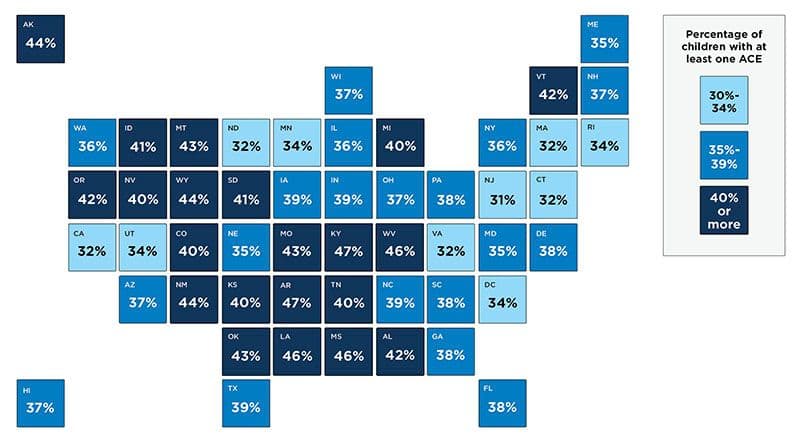
Source: These estimates are based on the authors’ analysis of the National Survey of Children’s Health (2018-2023).
As described in other Child Trends analyses of ACEs, the prevalence of ACEs at the national level was largely stable from just prior to the COVID-19 pandemic to 2023, with a small improvement. Similarly, most individual states experienced little to no change in prevalence over the same time period, with the exception of five states (Georgia, Maine, Ohio, Oklahoma, and Virginia) and the District of Columbia that had statistically significant declines of 7 percentage points or more. Michigan and New Mexico experienced marginally statistically significant declines of 6 and 7 percentage points, respectively.
ACEs are complex and encompass a range of experiences that have different root causes and require different intervention approaches. Over the time covered in this analysis, states have tried various approaches to preventing ACEs. For example, New Jersey created an Office of Resilience to coordinate efforts to address ACEs across the state. Other states, such as Indiana and Delaware, have created Children’s Cabinets to coordinate multiple agency and organizational efforts to promote child and youth well-being. Many states, including Tennessee and Virginia, have promoted the use of trauma-informed approaches. It takes time for successful prevention efforts to move the needle on the prevalence of ACEs across a population of children, so sustained investment and effort is critical.
National Survey of Children’s Health (NSCH): The NSCH is a nationally representative survey of children under age 18 in the United States (as well as within all 50 states and Washington, DC). The NSCH covers several topics related to children’s health and well-being, such as physical and mental health, access to and quality of health care, parent and family health, and neighborhood and community contexts. The survey is conducted annually by the U.S. Census Bureau and is funded by the U.S. Department of Health and Human Services, Health Resources and Services Administration, Maternal and Child Health Bureau. This analysis uses data from the 2018–2023 NSCH.
Adverse childhood experiences (ACEs): ACEs is a broad term referring to a range of circumstances or events that pose a serious threat to physical or psychological well-being in childhood. Some ACEs are potentially traumatic and can have lasting effects on health and well-being in childhood and later in life. The specific ACEs included in this analysis are below. In the NSCH a parent or guardian reports whether, at any point in the child’s life, the:
- Family had a hard time covering basic needs (e.g., food, housing) on the family's income
- Child’s parents or guardians divorced or separated
- Child’s parent or guardian died
- Child’s parent or guardian served time in jail
- Child saw or heard parents or adults slap, hit, kick, or punch one another in the home
- Child was a victim of violence or witnessed violence in their neighborhood
- Child lived with anyone who was mentally ill, suicidal, or severely depressed
- Child lived with anyone who had a problem with alcohol or drugs
- Child was treated or judged unfairly because of their race or ethnic group
Suggested citation
Sacks, V., Stafford, R., & Vivrette, R. (2026). State-level rates of adverse childhood experiences were largely stable from 2018 to 2023. Child Trends. DOI: 10.56417/4801g1749n