


%202-800x800.jpg&w=3840&q=75)
The prevalence of Adverse Childhood Experiences (or ACEs; see Glossary) declined from 2018 to 2023, but patterns of specific types of ACEs varied over this period. According to a new Child Trends analysis of the National Survey of Children’s Health (NSCH), declines in three specific ACEs stand out: income insecurity, parental divorce or separation, and parental incarceration. The percentage of children whose families ever had a hard time affording basic needs such as food and housing (income insecurity) declined substantially during the COVID-19 pandemic but has since increased, going from 15.5 percent in 2018 to 11.8 percent in 2021 before increasing to 14.2 percent in 2023. The percentage with parents or guardians who had divorced or separated declined from 23.6 percent in 2018 to 21.0 percent in 2023, while the percentage with a parent or guardian who had ever been incarcerated declined from 7.8 percent in 2018 to 5.8 percent in 2023. Parental divorce/separation and income insecurity have consistently been the most common ACEs tracked in the NSCH since 2018.
The prevalence of several adverse childhood experiences declined from 2018 to 2023
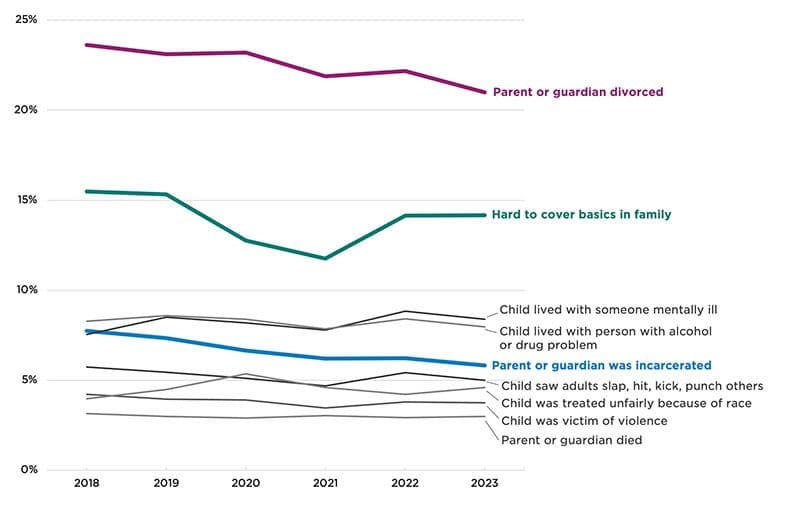
Source: These estimates are based on the authors’ analysis of the National Survey of Children’s Health (2018-2023).
Note: Only ACEs that were tracked every year from 2018 to 2023 are included in the graph.
These findings align with previous research indicating that child poverty declined dramatically during the COVID-19 pandemic and then increased to pre-pandemic levels following removal of pandemic-related social safety net supports. They also align with previous research finding that rates of divorce and separation—as well as incarceration—have declined in the United States in recent years.
One other ACE decreased slightly (by less than a percentage point) over this same period. The percentage of children who had seen or heard parents or adults slap, hit, kick, or punch one another in the home decreased from 5.7 percent in 2018 to 5.0 percent in 2023. The percentage has fluctuated since the pandemic, decreasing to 4.7 percent in 2021 before increasing to 5.4 percent in 2022. Other research on the incidence of domestic violence during and after the pandemic is somewhat mixed, but generally finds that rates increased.
One ACE also increased slightly across the same time period: The percentage of children who lived with someone who was mentally ill, suicidal, or severely depressed increased from 7.5 percent in 2018 to 8.4 percent in 2023. This aligns with the national trend wherein the percentage of adults with a diagnosed mental health condition has risen since before the pandemic.
In recent years, the NSCH has added questions for caregivers about children’s experiences of discrimination because of health conditions and sexual orientation or gender. In 2023, 1.9 percent of children ages 6-17 (note: this ACE is not tracked for younger children) had been treated unfairly due to their sexual orientation or gender, and 2.7 percent had been treated unfairly due to a health condition. These questions are asked for all children regardless of health condition or sexual orientation and gender, and the prevalence of these ACEs is likely much higher among children who have a health condition and those who identify as LGBTQ. For example, other youth-reported data suggest that over 37 percent of LGB youth ages 10-13 have experienced discrimination.
National Survey of Children’s Health (NSCH): The NSCH is a nationally representative survey of children under age 18 in the United States (as well as within all 50 states and Washington, DC). The NSCH covers several topics related to children’s health and well-being, such as physical and mental health, access to and quality of health care, parent and family health, and neighborhood and community contexts. The survey is conducted annually by the U.S. Census Bureau and is funded by the U.S. Department of Health and Human Services, Health Resources and Services Administration, Maternal and Child Health Bureau. This analysis uses data from the 2018–2023 NSCH.
Adverse childhood experiences (ACEs): ACEs is a broad term referring to a range of circumstances or events that pose a serious threat to physical or psychological well-being in childhood. Some ACEs are potentially traumatic and can have lasting effects on health and well-being in childhood and later in life. The specific ACEs included in this analysis are below. In the NSCH, a parent or guardian reports whether, at any point in the child’s life, the:
- Family had a hard time covering basic needs (e.g., food, housing) on family’s income
- Child’s parents or guardians divorced or separated
- Child’s parent or guardian died
- Child’s parent or guardian served time in jail
- Child saw or heard parents or adults slap, hit, kick, or punch one another in the home
- Child was a victim of violence or witnessed violence in their neighborhood
- Child lived with anyone who was mentally ill, suicidal, or severely depressed
- Child lived with anyone who had a problem with alcohol or drugs
- Child was treated or judged unfairly because of their race or ethnic group
- Child was treated or judged unfairly because of a health condition or disability
- Child was treated or judged unfairly due to sexual orientation or gender identity
Suggested citation
Sacks, V., Stafford, R., & Vivrette, R. (2026). Several adverse childhood experiences declined modestly from 2018 to 2023. Child Trends. DOI: 10.56417/5079u2208e