

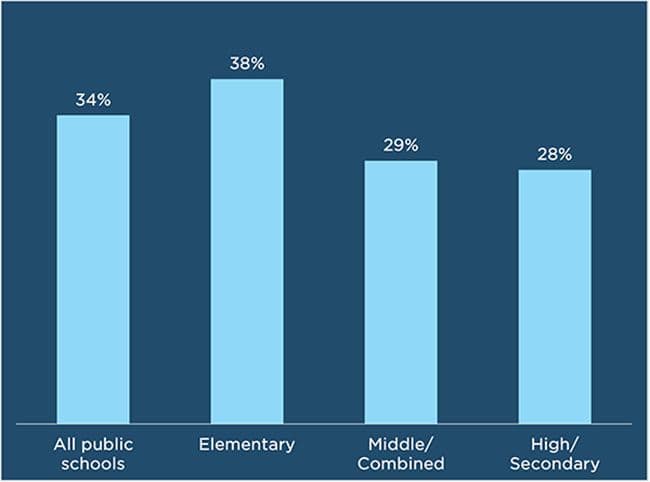
New federal data show a disconnect between school leaders’ confidence in using research and the frequency with which they actually use research sources to make decisions. According to the January 2025 School Pulse Panel, 81 percent of public school leaders report feeling mostly or very confident in applying research evidence to practice, policy, or program development. Yet only 34 percent say they “often” or “always” use peer-reviewed journal articles or empirical studies when writing, implementing, or revising programs or policies.


The gap between these leaders’ confidence and their actual use of research highlights the importance of research products—and research dissemination—that maintain the rigor and accuracy of research articles while also providing greater accessibility, relevance, and usability in the day-to-day work of school leadership.
Figure: School leaders who often or always use peer-reviewed journal articles or empirical studies
Source: U.S. Department of Education, Institute of Education Sciences, National Center for Education Statistics, School Pulse Panel 2024–25.
Helping school leaders put research into practice
Confidence in using research is a strong starting point, but it’s not enough on its own. For research to improve school outcomes, it must be both credible and usable. That means school leaders need access to information that is timely, clearly communicated, and relevant to their local context.
Many leaders face challenges in translating research findings into their day-to-day decisions, particularly when findings are hard to access or not designed with real-world constraints in mind. Research that supports change must reflect the complexity of school environments and provide practical entry points for action.
To help address this gap, Child Trends developed the PreK–12 Systems Change Resource Library, which includes publicly available tools and guidance designed to support decision makers working to improve schools. The resources draw from evidence but are built with practice in mind, offering examples and structures to help leaders apply research in meaningful ways.
Research has the potential to inform stronger decisions, but only if it is accessible, relevant, and connected to the realities of leading a school.
If you are interested in strengthening the connection between research and practice, we’d love to work with you. Contact Samantha Holquist at sholquist@childtrends.org.