




This guide is part of a resource library from Child Trends designed for practitioners, policymakers, and researchers who want to transform K-12 school systems to better meet the needs of students, families, and communities. This practice guide focuses on an improvement science strategy known as “need sensing” and its potential to aid in school system transformation.
Introduction to Need Sensing
Need sensing is an improvement science strategy that helps school leaders gather information and data on their school systems’ strengths and challenges. This information-gathering strategy usually involves talking to a wide array of stakeholders to capture these strengths and challenges. The heart of need sensing is trying to identify how to address an issue or challenge your school system is facing by learning about your target populations’ needs. Conducting need sensing can be the catalyst to address systemic issues and develop a plan to better serve the students within your school system.
Before diving into this practice guide, please note two important components beyond the main text. The first component is the need sensing in practice blurbs (highlighted in blue boxes), which provide examples of crucial aspects of need sensing. The second component includes resource stops (highlighted in yellow boxes), which link resources to further guide your need-sensing journey. These bonus components are meant to support and ease your need-sensing journey.
Need sensing in practice: Building relationships. Need sensing can also be used as a strategy to build relationships with your participants, who might be educators, students, and/or school leaders. For instance, in a project at Child Trends focused on transforming school systems through innovation and evidence building, the team used need sensing to kick-start technical assistance (TA) relationships. The need sensing not only served the purpose of collecting information needed to understand participants’ TA needs but also to start building trust and connection with participants. In this project, it was important to build relationships with participants to facilitate TA delivery and stimulate progress on the project. For this reason, need sensing can also be used as the foundation for relationship-building in a project.
RESOURCE STOP 1
To dive deeper into the background on improvement science—from which the need-sensing strategy is drawn—review this improvement science resource.
Need-sensing Framework and Process
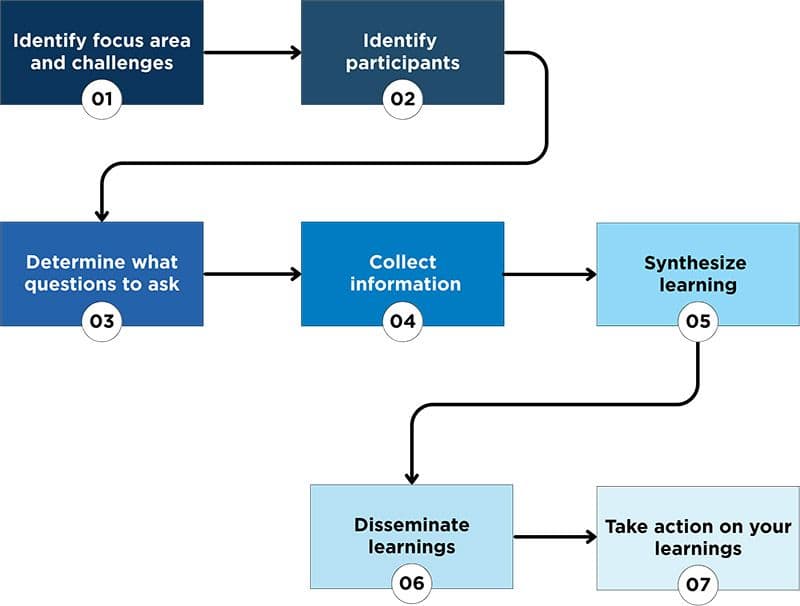
Need sensing is a formulaic process rooted in continuous improvement, with steps for gathering data that will guide your school transformation. The need-sensing framework shown below, guided by improvement science, provides guidance to your team engaging in need sensing to transform your school system.
Need sensing in practice: Seeking feedback. Throughout the need-sensing process, engage your participants and include them at every step. This inclusion might involve asking for feedback and input from educators, students, school leaders, and/or team members to refine your school transformation need-sensing approach. These participants’ insights and feedback can be instrumental in ensuring that your need-sensing strategy is successful and useful for school transformation.
Figure 1. Need-sensing Framework
1. Identify focus area and challenges.
Before jumping into need-sensing activities, identify the focus area(s) and challenge(s) you want to address in your school or classroom. By identifying the need or challenge, you will have a clear goal and vision of what you hope to learn from need sensing.
Need sensing in practice: Educator and student perspectives. The project team leading the need-sensing strategy may have a plan for how they want need sensing to unfold. But ultimately, if the change you want to invoke affects educators and students, it may be important to include them in the need-sensing process. This can be as simple as having informal conversations with educators and students or as formal as conducting a survey or focus group.
2. Identify participants.
Once you have identified the needs and challenges that your team intends to address, it is important to identify who you will engage to learn more about these issues and challenges. You should engage participants in need-sensing data collection: Participants can include teachers, students, and school administrators. Who you talk to will depend on who has information that can help you effectively address a need and/or challenge, and who you want to better serve. In identifying and working with participants, build connections and trust to authentically learn about them and their needs.
3. Determine what questions to ask.
The questions you decide to ask will depend on what you need to learn that will help you better address relevant needs and challenges. Questions should be aligned with a specific focus area and the challenges you are trying to tackle in your school system. Check out the next resource stop to access a question bank that can guide your need-sensing journey. Building relationships with your participants will help you develop questions because you’ll know the questions that your participants will respond to best and be able to share in-depth responses.
Need sensing in practice: How to develop and choose your questions. The questions you develop for your need-sensing journey will depend on what you hope to learn and who you need to talk to for answers. Take some time with your team; be intentional about this process. Brainstorm what kinds of questions your participants may respond to best and who on your team should ask these questions. For instance, does someone on your team already have a good relationship with your intended participants? They may be integral in helping develop the questions and talking to participants.
RESOURCE STOP 2
To access questions that can guide your need-sensing journey, look at this question bank.
4. Collect information.
The next step in the process is to collect information. Activities such as surveys, focus groups, interviews, and check-in calls can help you collect the necessary information to address your focal needs and challenges. When collecting information and data, engage and incorporate your team and participants in ways that benefit the purpose of need sensing. For instance, if you want to gather information on students, consider having students lead survey development or conduct focus group sessions with other students. In other words, consider how you collect your information and who collects it.
5. Synthesize learning.
After you have collected the necessary information, you and your team will synthesize what you learned from the need-sensing activities. By synthesizing and summarizing your learnings, you can determine how to best tackle your school or classroom needs and challenges. Involve your participants in the process: Their perspectives on what was learned and what comes next are valuable.
6. Disseminate learnings.
Finally, curate and share your learnings with your participants to ensure their perspectives are included. A summary of your learnings can take the form of a report or plan of action; share via a flowchart with next steps, a standard two-page summary report, or even PowerPoint slides that summarize your findings and detail your next steps.
Need sensing in practice: Disseminating your learnings. Your learnings can be disseminated in multiple formats depending on your audience. Consider engaging participants in reviewing dissemination materials (and their formats) to ensure that the chosen audience will understand them. Here are some examples, with accompanying Child Trends resources, of how you can disseminate your learnings:
Example 1: Feature your participants in your learnings via interviews: Students and Communities Can Be Better Served via Partnerships Between Community Organizations and Schools
Example 2: Share data findings that were co-analyzed and co-written with participants: Adapted Measure of Math Engagement
Example 3: Use a community-engaged research approach: A Practical Guide to Getting Started With Community-Engaged Research
7. Take action on your learnings.
Finally, once you’ve made it through the six preceding steps, you’ll develop and implement next steps based on your learnings and the initial vision and goal you set at the beginning. The implementation of next steps will determine whether what you learned will make a difference in your vision and goal for school transformation. If you do not achieve the intended results, you can repeat the process or identify where you can adapt it to gain the needed learnings.
Conclusion
Need sensing is an important improvement science strategy that can help create solutions for school system transformation. Need sensing is an integral part of building relationships for school transformation and should be rooted within your strategic building process to ensure that your desired changes are sustainable. We hope this practice guide provides insight on using need sensing to help you and your team improve the classroom and overall school experience for students.
Resources
- Comprehensive Resource Library for Leading PreK-12 Education Systems Change – Development (Child Trends, 2025)
- Steps to Guide Sustainable Change in School Systems (Samantha Holquist, Lorena Aceves, Mara Schanfield, and Olivia Reyes, Child Trends, 2025)
- Analyzing a Problem: The Basics of Phase 1 (New York City Department of Education, 2024)
- Continuous Improvement in Education: A Toolkit for Schools and Districts (Karen Shakman, Diana Wogan, Sheila Rodriguez, Jared Boyce, and Debra Shaver, 2020)
- Fostering Continuous Improvement (Dr. Paul J. Bloomberg, 2024)
Suggested citation
Aceves, L., Ball, J., Holquist, S., & Guros, C. (2025). Using need sensing activities to transform your school system. Child Trends. DOI: 10.56417/7235k5981l