
New data from the 2024 National Assessment of Educational Progress (NAEP) show that just 39 percent of fourth graders and 28 percent of eighth graders scored at or above a “proficient” level in math. While this reflects a slight improvement from 2022 (36% for fourth graders and 26% for eighth graders), scores remain below 2019 levels—41 percent and 34 percent, respectively—highlighting a continued need to strengthen math achievement nationwide.

While math is foundational to students’ academic success and future opportunities—jobs in science, technology, engineering, and math (the STEM fields) are predicted to jump more than 10 percent over the next decade—many students feel disconnected from how math is taught and unsure of its relevance. A renewed focus on students’ math engagement, in addition to high-quality math instruction, may offer schools a powerful strategy to improve math learning.
Figure: Just under 40 percent of fourth graders and 30 percent of eighth graders score at or above a proficient level (including advanced) in math
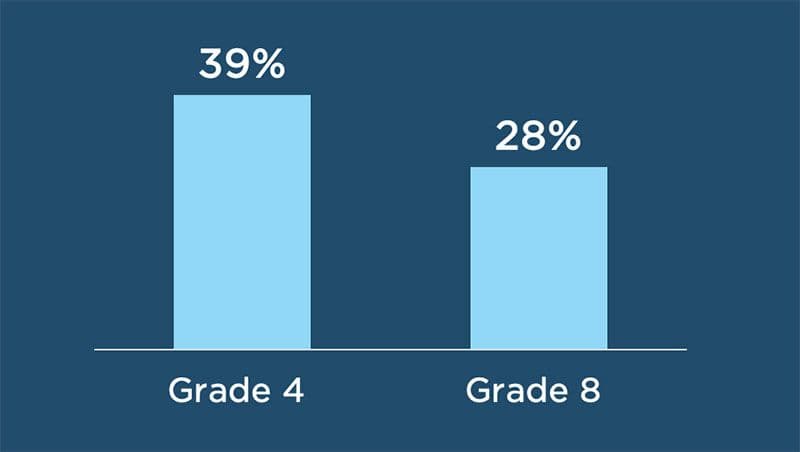
Note: Some apparent differences between estimates may not be statistically significant.
Source: U.S. Department of Education, Institute of Education Sciences, National Center for Education Statistics, National Assessment of Educational Progress (NAEP), 2024 Mathematics Assessment.
Reimagining engagement to transform math learning
When students are not engaged, they are less likely to learn. And in many classrooms, math instruction can feel disconnected from students’ lived experiences, overly procedural, or unwelcoming. At Child Trends, our Adapted Measure of Math Engagement project partnered with Black and Latino middle and high school students and their teachers to better understand meaningful engagement in math.
Together, we explored what it means to feel engaged in math class. Students told us that real engagement happens when they’re treated as thinkers, not just learners—when teachers listen to their reasoning, encourage different ways of solving problems, and create space for mistakes as part of learning. Engagement, they said, grows when the classroom reflects who they are, their names are pronounced correctly, their communities are part of the conversation, and math connects to goals that matter to them. Feeling respected and seen isn’t abstract; it’s about being known and challenged in ways that feel personal and purposeful.
The students also made clear that math engagement is not just nice to have; rather, it’s a foundation for math learning. The NAEP data make a strong case that education systems should revisit how students experience math instruction. When schools support engagement, they build pathways to better outcomes, stronger confidence, and deeper connections to learning.
Looking to partner with Child Trends on improving math engagement? Contact Samantha Holquist at sholquist@childtrends.org.