

A new analysis of American Community Survey (ACS) data from 2018 to 2022 finds that grandparent co-residence is common among households with American Indian and Alaska Native (AIAN) children under age 18, particularly when children live with no parents or only one parent. Approximately half (53%) of AIAN children with no parents present in the home lived with at least one grandparent during this period. Among those living with a single father, 43 percent lived with at least one grandparent, compared to 34 percent living with a single mother. In contrast, only 8 percent of AIAN children living with two married parents and 3 percent living with cohabiting parents also had at least one grandparent in their household.
AIAN children were more likely to live with a grandparent when they lived with no parents or only one parent than when they lived with two parents
Percentages of grandparent co-residence among AIAN children under age 18 by family structure (married parents, cohabiting parents, single father, single mother, no parents), 2018-2022
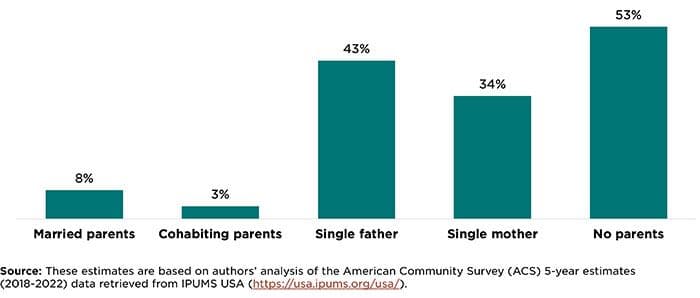
These estimates are based on authors’ analysis of the American Community Survey (ACS) 5-year estimates (2018–2022) data retrieved from IPUMS USA (https://usa.ipums.org/usa/).
For this analysis, AIAN identity includes those with race reported as AIAN only (i.e., non-Hispanic, no other racial/ethnic category selected). Children are defined as persons under age 18. Parents include biological, adoptive, and stepparents, as well as the unmarried partner of the child’s parent who lives in the same household. Grandparents are defined as individuals living in the same household with their biological, adoptive, or step-grandchildren under age 18, as identified through IPUMS family interrelationship variables or ACS grandparent indicators. Person weights provided by the U.S. Census Bureau are applied to yield nationally representative estimates. Parent indicators generated by IPUMS were used to obtain co-resident parents’ basic demographic information.
Within AIAN communities, grandparent co-residence may be driven by cultural values and preferences related to intergenerational caregiving; and by challenges related to adverse family and community conditions, such as poverty, housing instability, or parental absence. Findings from our analysis suggest that grandparent co-residence is more common among family structures that may benefit from additional child caregiving support (i.e., single-parent and no-parent households), highlighting the importance of thinking beyond two-generation parent-child family structures when designing programming, research and evaluation, and policy initiatives for AIAN families.
The roles of grandparents within the lives of AIAN children have shifted over time. Historically, grandparents served as pillars of wisdom, tradition, and cultural preservation. Grandparents are entrusted with the responsibility of passing down oral histories, spiritual teachings, and Tribal values to younger generations. They are essential connectors of the past and present, ensuring the survival of cultural heritage and fostering a sense of Tribal identity within families. This intergenerational bond extends beyond the immediate family, as grandparents often play an integral role more broadly as Elders in Tribal ceremonies, storytelling, and educating children and community members about their ancestry and kinship connections. Grandparents’ wisdom and experiences are considered invaluable and they are held in high regard within Tribal Nations and community contexts.
Today, while many grandparents continue to hold revered and central roles in AIAN families and communities, their roles have evolved in response to contemporary social and economic challenges. With limited access to affordable child care and persistent economic hardships in some Tribal communities, grandparents increasingly serve as primary and sole caregivers for their grandchildren. They provide stability and support in multi-generational households, particularly when their adult children face barriers such as unemployment or housing insecurity. Moreover, as they help their families navigate these challenges, grandparents continue to act as cultural and emotional anchors, fostering resilience in their families and communities. Grandparents’ dual role as caregivers and cultural stewards underscores their enduring importance; their need for tailored resources; and their need for programming, research and evaluation, and policy that recognize and support their contributions to the well-being of AIAN families.
We analyzed the American Community Survey (ACS) 5-year estimates (2018–2022) data retrieved from IPUMS USA (https://usa.ipums.org/usa/). For this survey, a household respondent identified by the U.S. Census Bureau indicates for themselves—or for another member of the household—whether a household member is American Indian or Alaska Native (AIAN), with the following examples provided by the Bureau—Navajo Nation, Blackfeet Tribe, Mayan, Aztec, Native Village of Barrow Inupiat Traditional Government, Nome Eskimo Community, etc. For this analysis, AIAN children are individuals under age 18 for whom AIAN only is reported as their racial/ethnic identity (i.e., non-Hispanic, no other racial/ethnic category selected). The ACS collects data on each household member’s relationship with the household head. IPUMS identifies parents and probable parents (if direct information is not available)—including biological parents, adoptive parents, stepparents, and the unmarried partner of a child’s parent—for all individuals in the household. Grandparents are defined according to IPUMS USA’s family interrelationship variables as household members whose relationship to the household head is recorded as “grandparent.” This designation is derived from the RELATE variable in specific Census years (e.g., 1980, 1990, 2000) and can be inferred through parental link variables (MOMLOC and POPLOC) to identify grandparent–grandchild relationships within the household structure. We applied the U.S. Census Bureau person weight variable to yield nationally representative estimates of AIAN children who lived in U.S. households from 2018 to 2022.
Acknowledgments
The authors thank the following Child Trends staff members for their reviews and feedback on this datapoint: Matt Haugen, MA; Brent Franklin, MPP; Renee Ryberg, PhD, MA; Catherine Nichols, JD; Krystal Figueroa; and KT Rust.
Suggested citation
Pourier, J., Chen, Y., Martinez, D. N., & Around Him, D. (2025). Grandparent co-residence is common when American Indian and Alaska Native children live with single or no parents. Child Trends. DOI: 10.56417/1727c5380t