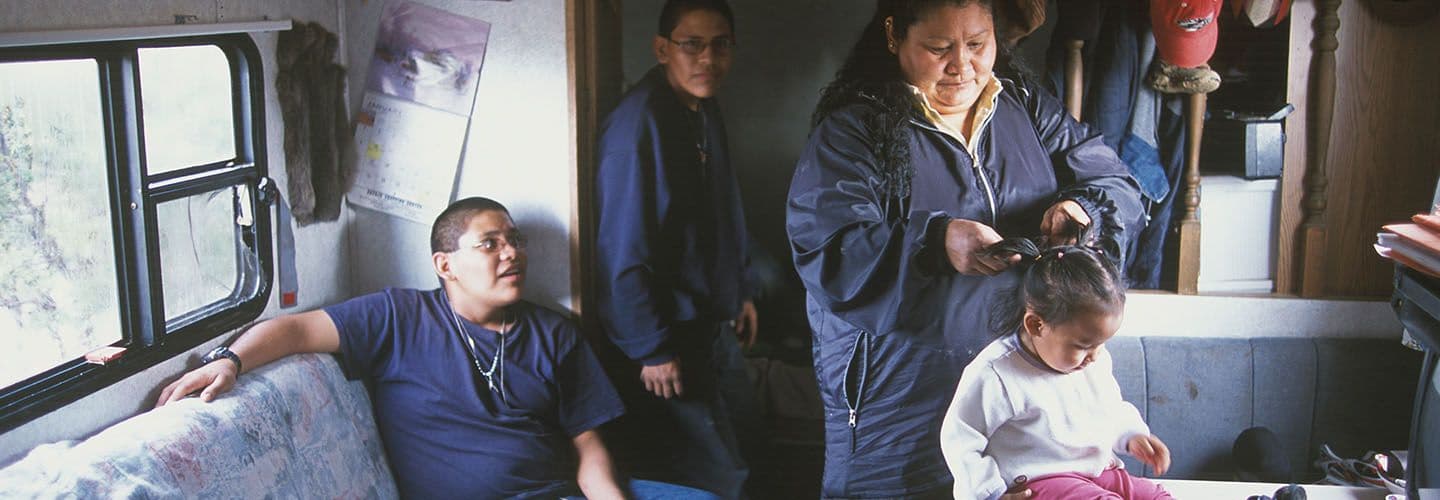


A new analysis of American Community Survey (ACS) data from 2018 to 2022 finds that a sizeable share (23.3%) of American Indian and Alaska Native (AIAN) children under age 18 lived with a grandparent, or nearly twice the percentage among all U.S. children (12.4%). Among AIAN children who lived with a grandparent, the majority also lived with at least one parent (16.7% of all AIAN children, compared to 10.4% for all U.S. children), meaning that they lived in a three-generation household. Approximately 6.5 percent of all AIAN children lived with only a grandparent (or grandparents), or more than triple the rate of 2.1 percent among all U.S. children.
23.3 percent of AIAN children lived with at least one grandparent in 2018-2022, and most also lived with at least one parent
Percentages of AIAN children under age 18 living with both parents and grandparents (three-generation household) and with only grandparents, 2018-2022
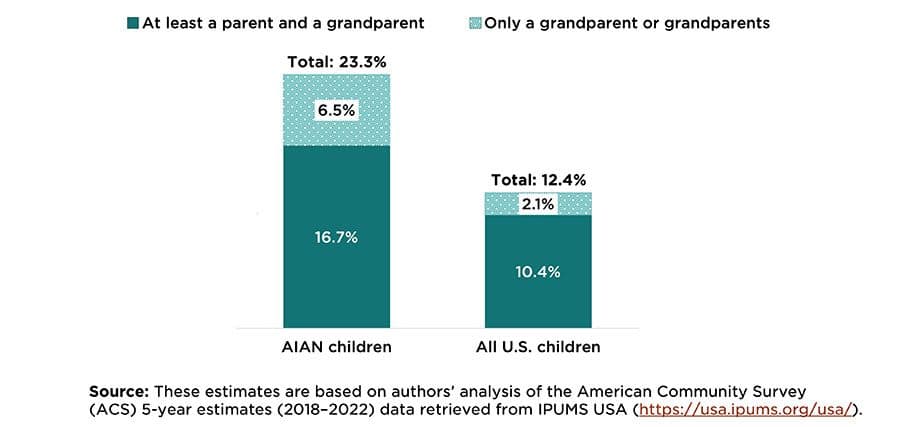
These estimates are based on authors’ analysis of the American Community Survey (ACS) 5-year estimates (2018–2022) data retrieved from IPUMS USA (https://usa.ipums.org/usa/).
For this analysis, AIAN identity includes those with race reported as AIAN only (i.e., non-Hispanic, no other racial/ethnic category selected). Children are defined as persons under age 18. Parents include biological, adoptive, and stepparents, as well as the unmarried partner of the child’s parent who lives in the same household. Grandparents are defined as individuals living in the same household with their biological, adoptive, or step-grandchildren under age 18, as identified through IPUMS family interrelationship variables or ACS grandparent indicators. Person weights provided by the U.S. Census Bureau are applied to yield nationally representative estimates. Due to rounding, totals by group (i.e., at least a parent and grandparent, only a grandparent or grandparents) do not exactly add to totals for AIAN children or for all U.S. children.
Among AIAN children, the higher percentage of grandparent co-residence may be driven by a variety of factors, underscoring the importance of considering family structure when designing and implementing policies and programs that aim to support AIAN child well-being. Grandparent co-residence, for example, may reflect cultural beliefs and practices related to intergenerational caregiving. For AIAN children, grandparents can play an essential role in conveying knowledge of cultural traditions, worldviews, and languages, which is vital to the cultural continuance of AIAN communities. Thus, AIAN children living with their grandparents, in two-generational or three-generation households, may signal a positive, culturally congruent pathway toward supporting child, family, and community well-being.
Grandparent co-residence may also reflect adaptive responses to family and community conditions. For instance, grandparents may serve as AIAN children’s primary or supporting caregivers due to either positive factors—such as temporary parental relocation to pursue employment or educational opportunities—or destabilizing factors, such as parental incarceration or experiences of unemployment and poverty. AIAN children (and the AIAN population overall) disproportionately experience poverty, relative to some other racial and ethnic groups. Moreover, some Tribal communities face greater economic challenges than others, such as fewer employment opportunities and limited access to high-quality housing and child care. These population characteristics and community conditions may make grandparent co-residence a necessity rather than a choice.
While multigenerational households can help alleviate financial strain and support the caregiving needs of both children and elder adults, they may also result in challenges related to limited physical space and uneven responsibilities for household expenses, chores, and caregiving. However, the support that families in three-generation households need is likely notably different from that needed in two-generation households where grandparents are the primary caregivers of grandchildren. In these instances, families may need case management support, legal assistance, and respite care and may benefit from policy and programmatic solutions offered by innovative efforts like New Mexico’s Kinship Caregiver Support Pilot program. With nearly one in four AIAN children living with at least one grandparent, attention to their family structures—and to the different needs of two-generation versus multigeneration households—may help decision makers better meet the needs of AIAN children and those who care for them.
We analyzed the American Community Survey (ACS) 5-year estimates (2018–2022) data retrieved from IPUMS USA (https://usa.ipums.org/usa/). For this survey, a household respondent identified by the U.S. Census Bureau indicates for themselves—or for another member of the household—whether a household member is American Indian or Alaska Native (AIAN), with the following examples provided by the Bureau—Navajo Nation, Blackfeet Tribe, Mayan, Aztec, Native Village of Barrow Inupiat Traditional Government, Nome Eskimo Community, etc. For this analysis, AIAN children are individuals under age 18 for whom AIAN only is reported as their racial/ethnic identity (i.e., non-Hispanic, no other racial/ethnic category selected). The ACS collects data on each household member’s relationship with the household head. IPUMS identifies parents and probable parents (if direct information is not available)—including biological parents, adoptive parents, stepparents, and the unmarried partner of a child’s parent—for all individuals in the household. Grandparents are defined according to IPUMS USA’s family interrelationship variables as household members whose relationship to the household head is recorded as “grandparent.” This designation is derived from the RELATE variable in specific Census years (e.g., 1980, 1990, 2000) and can be inferred through parental link variables (MOMLOC and POPLOC) to identify grandparent–grandchild relationships within the household structure. We applied the U.S. Census Bureau person weight variable to yield nationally representative estimates of AIAN children who lived in U.S. households from 2018 to 2022.
Acknowledgments
The authors thank the following Child Trends staff members for their reviews and feedback on this datapoint: Matt Haugen, MA; Brent Franklin, MPP; Renee Ryberg, PhD, MA; Catherine Nichols, JD; Krystal Figueroa; and Katelyn V. Rust.
Suggested citation
Pourier, J., Chen, Y., Martinez, D.N., & Around Him, D. (2025). American Indian and Alaska Native children twice as likely to live with grandparents. Child Trends. DOI: 10.56417/4035z5086k