


%202-800x800.jpg&w=3840&q=75)
In 2023, 37.5 percent of children experienced at least one adverse childhood experience (ACE), a small but statistically significant improvement from 39.8 percent in 2018.[1] According to a new Child Trends analysis, the percentage of children (birth to age 17) who experienced ACEs remained relatively stable from 2018 to 2020, but has fluctuated modestly since the start of the COVID-19 pandemic. More specifically, the percentage of children with at least one ACE decreased significantly from 2020 to 2021 (39.4% to 37.1%), increased significantly from 2021 to 2022 (37.1% to 38.9%), and then decreased from 2022 to 2023 (38.9% to 37.5%). While these changes are statistically significant, they are still small.
Adverse childhood experiences, or ACEs, broadly refer to a range of childhood circumstances or events that pose a serious threat to physical or psychological well-being, and are associated with many negative physical and mental health outcomes throughout the lifespan. As research on ACEs has expanded over the past 25 years, so has our understanding of how these experiences affect our bodies and brains, the importance of protective positive childhood experiences, and the value of preventing ACEs.
See the Glossary at the bottom of this page for more information on ACEs and our data source.
Figure. The percentage of children with at least one adverse childhood experience declined from 39.8 percent in 2018 to 37.5 percent in 2023
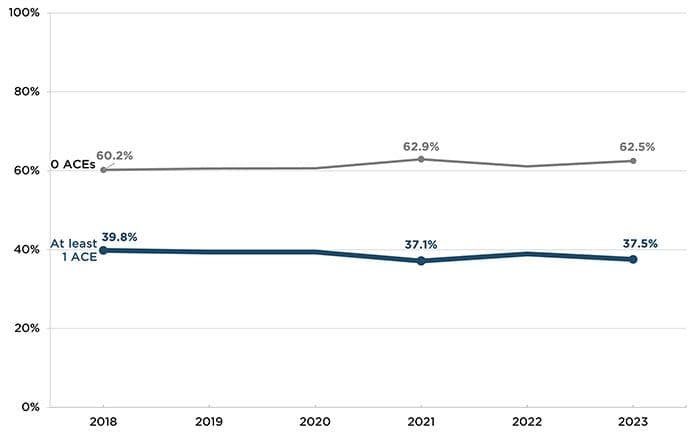
Source: These estimates are based on the authors’ analysis of the National Survey of Children’s Health (2018-2023).
Although our analysis indicates that the prevalence of ACEs has declined slightly over the past six years, these improvements are modest, particularly in light of the increased focus on preventing ACEs and greater awareness of the effects of trauma in childhood over the same period. This estimate of prevalence aligns with research on ACEs over the past 25 years that has consistently found that ACEs are common, with more than half of people experiencing at least one, depending on the population and types of ACEs studied. However, it is encouraging that the prevalence of the particular nine ACEs used in this analysis (see Glossary) improved in the early years of the COVID-19 pandemic, a period of high parental stress, social isolation, and disruption of community services.
Finally, it is critical to understand that negative experiences such as ACEs are not the entire story of a childhood, nor are they a guarantee of later negative outcomes. ACE type, frequency, and severity play important roles in later life outcomes, as do protective factors. Upcoming data points will report on state prevalence of ACEs and on the prevalence of specific ACEs at the national level.
National Survey of Children’s Health (NSCH): The NSCH is a nationally representative survey of children under age 18 in the United States (as well as within all 50 states and Washington, DC). The NSCH covers several topics related to children’s health and well-being, such as physical and mental health, access to and quality of health care, parent and family health, and neighborhood and community contexts. The survey is conducted annually by the U.S. Census Bureau and is funded by the U.S. Department of Health and Human Services, Health Resources and Services Administration, Maternal and Child Health Bureau. This brief uses data from the 2018–2023 NSCH.
Adverse childhood experiences (ACEs): ACEs is a broad term referring to a range of circumstances or events that pose a serious threat to physical or psychological well-being in childhood. Some ACEs are potentially traumatic and can have lasting effects on health and well-being in childhood and later in life. The specific ACEs included in this analysis are below. In the NSCH, a parent or guardian reports whether, at any point in the child’s life, the:
- Family had a hard time covering basic needs (e.g., food, housing) on family's income
- Child's parents or guardians divorced or separated
- Child's parent or guardian died
- Child's parent or guardian served time in jail
- Child saw or heard parents or adults slap, hit, kick, or punch one another in the home
- Child was a victim of violence or witnessed violence in their neighborhood
- Child lived with anyone who was mentally ill, suicidal, or severely depressed
- Child lived with anyone who had a problem with alcohol or drugs
- Child was treated or judged unfairly because of their race or ethnic group
Footnote
[1] The data for this analysis come from the National Survey of Children’s Health (NSCH). The term ACEs can be used to refer to many different types of experiences, and several important experiences are not tracked by the NSCH—specifically, abuse and neglect. Therefore, the estimates in this analysis are likely an undercount of the percentage of children who have experienced ACEs. See the Glossary for more information.
Suggested citation
Sacks, V., Stafford, R., & Vivrette, R. (2025). Adverse childhood experiences remain stable, with modest declines since the COVID-19 pandemic. Child Trends. DOI: 10.56417/6485a8551q