
Latino Families Flourishing
A strengths-based, data-driven initiative to support Latino families and transform the systems and narratives that shape their lives
The Latino Families Flourishing (LFF) initiative harnesses the power of data to strengthen how we understand, measure, and support the flourishing of Latino families. Our goal is to center the diverse strengths and experiences of the Latino population in the United States and generate data that can drive meaningful systems and narrative change. By collaborating with communities, researchers, policymakers, and practitioners, we aim to inform and transform systems through better data, thereby ensuring that Latino families and communities have access to the opportunities and resources they need to thrive. The multi-year LFF initiative is led by Child Trends’ Hispanic Institute and supported by the Robert Wood Johnson Foundation (RWJF).
Products
This brief presents findings from our focus groups with Latino parents and caregivers about what “flourishing” means to them. Anchored by what we learned from these focus groups, this blog describes how—and why—we engaged community and organizational leaders to inform our national survey.

SIGN UP FOR OUR NEWSLETTER
Why LLF's Work Matters
Latino families—with all their diversity in culture, language, immigration and colonization histories, and family structures—are a cornerstone of the United States’ past, present, and future. Today, one in four U.S. children is Latino, a figure estimated to rise to one in three by 2050. These families bring deep strengths, resilience, and cultural assets to their children and communities.
All Latino families and children can flourish—and most Latino families have the key ingredients to live healthy, happy, and successful lives. However, the data and systems that shape policy, programs, and public narratives too often fail to reflect Latino families’ complexity or capture how they themselves define well-being and success.
We need more comprehensive national data on Latino families to present a complete picture of who they are, what their strengths are, and how the systems they interact with promote or hinder their opportunities to flourish. This will inform more effective, responsive, and data-driven policies and interventions to support flourishing among Latino families and communities.
Our Approach
Research
To bolster the research data infrastructure to examine Latino families’ strengths and diverse characteristics, we are developing and will soon administer a national survey of Latino families. The survey is designed to capture the ways in which families are flourishing, based on their own perspectives on what flourishing looks like, and the various ways systems either support or hinder that flourishing.
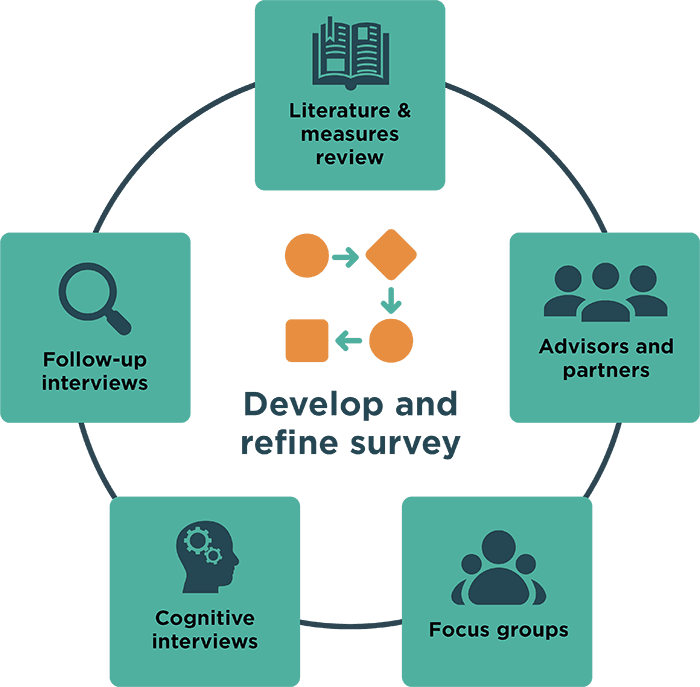
The survey development process is iterative, collaborative, and informed by focus groups with parents and caregivers, available literature, input from advisors and leaders with professional and lived experience across a variety of aspects of Latino family life, and cognitive interviews. The survey will be fielded through an existing panel, in both English and Spanish. We will also interview caregivers to contextualize early findings from the survey.
The goal is to build the infrastructure needed to sustain an ongoing national survey that can monitor trends in well-being at the population level, observe developmental changes within Latino families over time, and capture economic and social shifts in real time.
Partnership, collaboration, and communications
To ensure that our efforts yield data that are useful and can drive change, we conduct continuous outreach to Latino-serving organizations, researchers, program administrators, advocates, and those who work in policy. Through the establishment of regular working groups, we aim to collaboratively shape survey content, interpret findings for policy and program implications, and connect findings to systems reform and narrative change. We will also create and disseminate resources—such as a user’s guide, briefs, and profiles of Latino families—that support the use of LFF survey data for informing programs and policies.
Community mobilization
We will partner with national organizations and community leaders to translate our survey findings into actionable insights and ensure that those insights are accessible to community members, policymakers, and communicators. We will work with communities to fully leverage the findings to support narrative change and systems reform within their contexts.
About the LFF Logo
LFF’s logo draws inspiration from the image of a family gathered around the dinner table—a cherished tradition among many Latino families that symbolizes unity, shared values, and well-being. This everyday act reflects strong family bonds and a culture of generosity, embodied in the saying, “Donde comen dos, comen tres”— “Where there is enough food for two, there is enough for three.”
The circular form of the logo represents the protective nature of family, while the sun at its center symbolizes the broader systems that nurture and support family flourishing. Vibrant colors celebrate the richness and vitality of Latino culture, honoring its warmth, resilience, and spirit of togetherness.
LFF’s Core Beliefs
- All Latino families and children have the ability to flourish, and most Latino families have the key ingredients to live healthy, happy, and successful lives.
- Systems, policies, programs, and practices at multiple levels can lift or limit Latino families' and children's abilities to reach their full potential.
- Latino children and families bring many strengths and cultural assets that should be leveraged to promote their well-being.
- Adequate data represent an essential first step toward enhancing our understanding of Latino families’ diverse, current, and intersectional characteristics and experiences. These data allow us to highlight the ways in which families are flourishing, to change narratives to emphasize strengths instead of deficits, and to inform systems that promote Latino families' well-being.
- Centering the Latino experience—with limited comparisons to other groups—allows us to explore, appreciate, and amplify Latino families’ diversity and strengths from an intersectional perspective.
Our Team
Child Trends
- María A. Ramos-Olazagasti, principal investigator
- Katy Falletta, research project manager
- Lina Guzman, senior advisor
- Doré LaForett, constituent engagement and collaboration lead
- Lauren Zarick, communications and dissemination lead
- Laura Ramirez, research assistant
Research and Survey Working Group
- Dolores Acevedo-Garcia, Boston University
- Cristi Carman, RAPID Survey Project, Stanford Center on Early Childhood
- Wendy Castillo, Montclair State University
- José Causadias, Center for Educational Research (CIEDU)
- Rodrigo Dominguez-Villegas, Latino Policy & Politics Institute, University of California, Los Angeles
- Lillian Durán, University of Oregon
- Mark Hugo Lopez, Pew Research Center
- Juan Manuel Pedroza, Latino Policy & Politics Institute, University of California, Santa Cruz
- Krista Perreira, University of North Carolina at Chapel Hill
- Gabe Sanchez, BSP Research and University of New Mexico
Contact Us
For questions and to engage with our work, please contact us at lff@childtrends.org.
LFF is launching alongside a parallel but distinct effort also funded by RWJF—the Black Families Flourishing (BFF) Project—a project with principles and objectives that are aligned with those of the LFF Project.