
The 2022 Dobbs v. Jackson Women’s Health Organization decision from the United States Supreme Court (the Dobbs decision) ended the constitutional right to an abortion and gave individual states the authority to regulate abortion care. Prior to the Dobbs decision, it was estimated that almost one in four women (24.7%) would have had an abortion in their lifetime. However, following the decision, many states enacted total or near-total bans on access to abortion care.
People with lower incomes often rely on publicly funded family planning care to meet their fertility goals. Understanding post-Dobbs changes in reproductive health care behavior among this population can help family planning providers offer the best care possible moving forward. To this end, we analyzed data collected in October 2023 from a survey of 1,016 women ages 18 to 34 who had received family planning care in the past 12 months and who were income-eligible to receive publicly funded services. At the time of data collection, 14 states had implemented total abortion bans and 11 had enacted gestational limits between 6 and 22 weeks.[1]
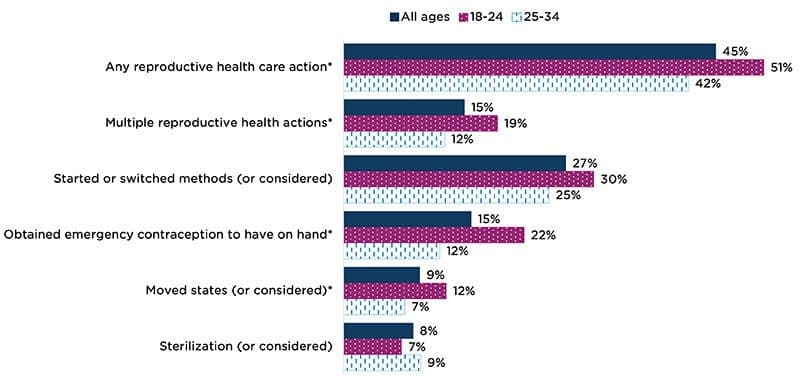
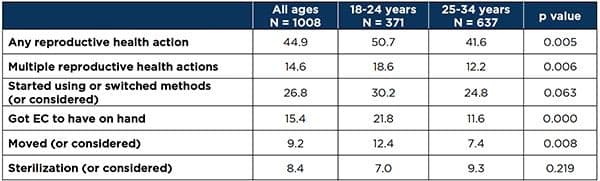
In the survey, we asked respondents what reproductive health care actions they had taken, if any, following the Dobbs decision. We found that just under half (44.9%) took—or considered taking—at least one of the options presented (or some other option), and roughly one in seven (14.6%) took or considered taking more than one option (See Figure 1 and Table A1).
Figure 1. Just under half of surveyed family planning clients with low incomes took a reproductive health care action (or considered doing so) following the Dobbs decision.
The percentage of women with low incomes, ages 18-34, who had received family planning care in the past 12 months reporting each reproductive health action
Source: Authors’ analysis of Child Trends' 2023 online survey of 1,016 patients with household incomes at or below 250 percent of the federal poverty level, who received family planning care in the prior year.
Notes: Chi-square tests to determine differences in these responses by age (18-24 vs. 25-34). Only estimates that differed significantly (p<0.05) across the two age groups are discussed in the text and are noted with an * in Figure 1. Sample includes the 1,008 respondents who provided valid responses to a survey item regarding actions taken following Dobbs.
Starting to use a method of contraception or switching to a more effective method (or considering doing so) were the most commonly reported actions selected by respondents in our sample (26.8%), followed by obtaining emergency contraception (EC) to have on hand (15.4%; see Figure 1). These results are similar to those found by researchers who looked at post-Dobbs actions among a sample of tele-contraception patients. Just under 10 percent of our sample reported that they had moved out of state (or had considered doing so) and a similar percentage reported that they had received a sterilization (or considered doing so).
We also looked at differences, by age of respondent, in the likelihood of taking (or considering) each of the reproductive health actions. Young adults (ages 18-24) are more likely to seek out abortion care than older women (ages 25-34) and face more barriers to accessing abortion care when they do so. Thus, this younger age group might be particularly motivated to take additional precautionary reproductive health actions following the Dobbs decision. Specifically, our findings show that over half (50.7%) of the young adults in our sample reported taking (or considered taking) at least one reproductive health action following the Dobbs decision, compared to 41.6 percent of those ages 25 to 34; similarly, young adults were 50 percent more likely to have reported taking (or considered taking) multiple actions (18.6% vs 12.2%). Young adults were nearly twice as likely as those ages 25 to 34 to have obtained EC to have on hand (21.8% vs. 11.6%) and were more likely to have moved, or considered moving, out of state (12.4% vs. 7.4%).
People often rely on abortion care to meet their childbearing goals by allowing women to discontinue an unwanted pregnancy (i.e., if they have already had the number of children they want, including none) or a mistimed pregnancy (i.e., the pregnancy occurred earlier than they wanted). In some cases, abortion care is used to preserve the life and/or health of individuals with pregnancy complications. In a policy context where abortion care is more limited, family planning providers can continue to support their clients’ fertility goals and health—particularly for their younger clients—by ensuring that their clients are aware of what reproductive health care options are (or are not) available in their state and providing them with the information needed to access these services.
For this analysis, we used data that Child Trends collected via an online survey of 1,016 family planning patients ages 18 to 34, with household incomes at or below 250 percent of the Federal Poverty Level for 2023, and who had received an OBGYN wellness exam, birth control care, sexually transmitted infection (STI) testing or treatment, fertility or prenatal care, or a pregnancy test in the 12 prior months. Additionally, patients were eligible if they received their family planning services from a community health clinic, community clinic, or public health clinic; a family planning or Planned Parenthood clinic; a school or school-based clinic; or a public hospital without an overnight stay.
Using a question adapted from a survey conducted by KFF of tele-contraception patients, we asked respondents what reproductive health care action(s) they had taken (or, in some cases, considered) in response to the Dobbs decision (see Table A1 for question wording). Respondents could select multiple responses and could write in their own response. Those who only selected “prefer not to answer” (n = 8) were not included in this analysis, leaving 1,008 respondents in our sample. To produce the estimates in this brief, we ran univariate analyses that produced the percentages of survey respondents who reported at least one or more action, two or more actions, and each specific action. We additionally used chi-square tests to test for differences in these responses by age (18-24 vs. 25-34). Only estimates that differed significantly (p<.05) across the two age groups are discussed in the text (and are noted with an * in Figure 1).
Table A1. Client survey item on post-Dobbs reproductive health actions
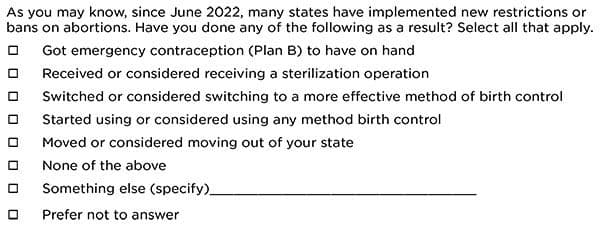
Table A2. The percentage of women with low incomes, ages 18-34, who had received family planning care in the past 12 months who reported taking a reproductive health action following the Dobbs decision
Source: Authors’ analysis of Child Trends' 2023 online survey of 1,016 patients with household incomes at or below 250 percent of the federal poverty level, who received family planning care in the prior year.
Notes: Chi-square tests to determine differences in these responses by age (18-24 vs. 25-34). Only estimates that differed significantly (p<0.05) across the two age groups are discussed in the text and are noted with an * in Figure 1. Sample includes the 1,008 respondents who provided valid responses to a survey item regarding actions taken following Dobbs.
Suggested citation
Pliskin, E., & Wildsmith, E. (2025). Many young family planning clients took reproductive health actions following Dobbs. Child Trends. DOI: 10.56417/139h2887g