






Over the past decade, family planning providers have prioritized efforts to deliver high-quality, patient-centered care. This approach to care focuses on clients’ sexual and reproductive health (SRH) care needs, goals, and values and is characterized by warm interactions with providers and staff, shared decision making, and ensuring that clients feel seen, heard, and respected. Patient-centered care has been shown to improve SRH-related health outcomes.
Through a grant from the Office of Population Affairs (OPA), Child Trends conducted a project to identify innovative and effective strategies to improve clients’ experiences during family planning visits. As part of this project, our team conducted interviews with two groups: (1) health care providers (e.g., physicians and nurse practitioners) and administrative staff from publicly funded family planning clinics and (2) women in households with low incomes who received family planning services in the past year, the population most likely to qualify for publicly funded services. These interviews gathered insights into the strategies already being used and ways family planning providers can improve client experiences during their visits.
This brief summarizes some of the key findings from an analysis of the interviews with women who received family planning services in the past year. Interview questions focused on understanding women’s experiences with the interpersonal aspects of their visits—that is, their interactions with staff and providers—and with the clinic itself—that is, their impressions of clinic facilities and the logistical elements of the visit. Following are some of the key interpersonal elements and clinic characteristics that made an SRH care visit a positive or negative experience and some client suggestions for improving SRH care service delivery.
Key Findings
- Interpersonal interactions with providers and staff were the most influential factors in shaping clients’ family planning visit experiences. These interactions not only came up most often but were also described in more emotional terms, indicating a deeper impact on clients’ overall sense of care and trust.
- Positive experiences were marked by feeling heard, respected, and supported. Clients emphasized the importance of active listening, empathy, and autonomy in decision making.
- Negative experiences—such as feeling dismissed, disrespected, or pressured—undermined trust and, in some cases, were so distressing that clients switched providers or discontinued care altogether.
- Clinic characteristics—such as scheduling logistics, the physical environment, and in-clinic wait times—also mattered but were less central to clients’ perceptions of a positive or negative visit. These factors were often described as inconveniences or frustrations rather than experiences that had a lasting emotional impact.
- Clients offered clear suggestions for improvement, including creating more welcoming and private clinic environments, establishing meaningful systems for client feedback and follow-up, strengthening providers’ bedside manner, ensuring clear and respectful communication about reproductive health topics, and fostering collaborative decision making that honors client autonomy and expertise in their own lives.
Participant Characteristics
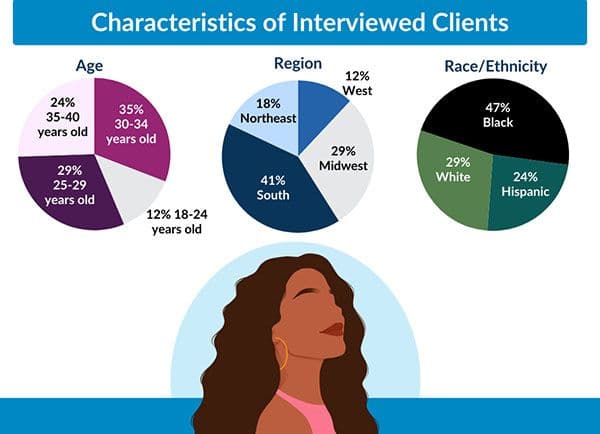
From March to May 2025, we conducted in-depth interviews with 17 family planning clients. All participants identified as female, were between 18-40 years old, and had household incomes below 250% of the federal poverty level. The largest share of clients were between the ages of 30 and 34 (35%, 6 clients), followed by those between the ages of 25 and 29 (29%, 5 clients). Nearly half (47%, 8 clients) identified as Black, and nearly one-quarter (24%, 4 clients) as Hispanic or Latina. Participants lived across all regions of the United States; the largest group was from the South (41%, 7 clients), followed by those from the Midwest (29%, 5 clients), while somewhat smaller percentages lived in the Northeast and West.
Factors that Contributed to a Positive or Negative SRH Care Visit
Interpersonal
Clients identified their interpersonal interactions with SRH care providers and clinic staff as being very important to how they felt about that care. Below, we describe how the following interactions shaped whether family planning clients’ visits were a positive or negative experience: providers’ bedside manner, their support of client autonomy, and their approach to providing thorough, comprehensive, and proactive care.
Providers’ Bedside Manner
Clients described how providers’ communication style, emotional sensitivity, and attentiveness shaped their overall experience of SRH care. Providers who listened closely, responded with empathy, and tailored care to clients’ needs helped foster comfort, trust, and safety. In contrast, rushed, judgmental, or physically insensitive care left some clients feeling dismissed, disrespected, or unsafe.
“When I was pregnant with my daughter, I was told that if I wanted attention, there was better ways of getting it than going to the clinic to have checkups… that same night I had my daughter two months early.” 31-year-old client living in the West
Overall, clients emphasized that they wanted more than clinical competence; they valued genuine connection, understanding, and respect.
Aspects of provider bedside manner that shaped client experiences:
- Active listening: Clients appreciated providers who asked thoughtful questions, recalled past details, and demonstrated genuine engagement. When providers seemed distracted or rushed, care felt impersonal or transactional.
- Empathy and emotional support: Supportive providers who acknowledged clients’ emotions and treated them with compassion were especially valued during vulnerable moments. A lack of empathy—particularly when delivering difficult news—left clients feeling dismissed or overwhelmed.
- Taking concerns seriously: Clients emphasized the importance of being believed and taken seriously. Providers who validated concerns, explored symptoms thoroughly, or adjusted care accordingly helped clients feel heard. In contrast, some described feeling ignored or retraumatized when concerns were minimized.
- Personalized care: Small adjustments—like using smaller instruments or offering breaks—helped tailor care to individual needs and increase physical comfort. Providers who did not accommodate these needs or were rough with their hands or tools during internal exams left some clients, particularly those with a history of trauma, feeling anxious or physically vulnerable.
Client Autonomy
Clients emphasized the importance of feeling informed and in control during their SRH visits. Many valued providers who explained procedures clearly, presented options, and actively involved them in care decisions. These practices fostered a sense of partnership and respect. In contrast, when providers made assumptions, withheld information, or disregarded preferences, clients felt powerless, disrespected, or blindsided.
“I didn’t know I was gonna get an internal [sonogram]…So when I found out about that, I was very taken aback and nervous. And the technician on the spot was like, ‘We don’t have to do this,’ which took a lot of the pressure off for me. I was like talked to throughout it in a gentle way like, ‘this is only gonna be a couple of more seconds. Is this OK?’ and that helped me through the process a lot. I felt that the technician was really considerate about how uncomfortable and scary that experience was for me." 31-year-old client from the Northeast
Elements of client autonomy that influenced the care experience:
- Informed consent: Clients appreciated providers who consistently sought permission before touching them or proceeding with care. Respectful check-ins and consent language helped foster trust. When consent was assumed or overlooked, some clients felt uncomfortable or violated.
- Clear explanations of procedures: Step-by-step explanations helped clients feel informed and at ease. Walking clients through what to expect— especially during exams or invasive procedures—reduced anxiety. A lack of explanation often left clients feeling unprepared or confused.
- Presentation of options: Clients valued providers who explored a range of care options and invited their input. When only one course of action was presented, some clients felt forced to advocate for themselves or go along with decisions that did not reflect their needs or preferences.
- Respect for client decisions: Clients felt empowered when providers supported their care preferences—such as declining a procedure, pursuing tubal ligation, or following a birth plan—without judgment or unnecessary barriers. In contrast, providers who dismissed clients’ input or insisted they knew best undermined trust and made clients less willing to speak up in future visits.
- Tailored patient education: Clients appreciated when providers took time to explain health information in ways that felt relevant and accessible. In contrast, generic or incomplete information left some clients uncertain about next steps or the rationale behind care decisions.
Thorough, Comprehensive, and Proactive Care Practices
Clients described how provider preparation, coordination, and follow-up shaped the continuity and quality of care. Proactive communication, familiarity with their medical history, and timely referrals helped clients feel supported across their care journey. In contrast, missed follow-ups or disorganized systems contributed to care fragmentation—placing the burden on clients to coordinate their own care and leaving some feeling forgotten or unsupported.
“So with this place … things get done when they say they're gonna get done, and I don't have to keep calling back and keep reminding them and being put on hold and calling call centers and leaving a voicemail for a doctor that may or may not get back to me.” 38-year-old client living in the Midwest
Aspects of thorough and proactive care that supported positive client experiences:
- Familiarity with medical history: Clients appreciated when providers reviewed their charts in advance, which created time for more meaningful conversation. When providers did not recall past visits or recognize returning clients, it was frustrating to re-explain instead of focusing on current needs, and it left clients feeling overlooked.
- Follow-up communication: Providers who checked in after visits—by phone, through patient portals, or at future appointments—reassured clients and signaled continued investment in their care. Missed or unclear follow-up, such as not explaining the need to return after a medication abortion, left clients feeling confused and delayed their care by leaving clients to navigate next steps on their own.
- Care coordination and referrals: Clients valued streamlined referrals and coordination with other care teams. When referrals were forgotten, delayed, or required repeated follow-up, care was disrupted, and clients were left to advocate for themselves and coordinate their own care.
- Responsiveness: Clients appreciated being encouraged to reach out with questions or concerns—and receiving timely replies. In contrast, unanswered messages or unacknowledged feedback—such as about long waits or insensitive treatment—left some feeling ignored and less likely to speak up in the future.
Clinic characteristics
Clients also highlighted a range of structural and logistical factors that influenced their ability to access SRH care and their experiences receiving it. Following, we describe positive and negative experiences related to the physical clinic environment and overall clinic accessibility.
Clinic Environment
Clients described several physical and procedural aspects of the clinic environment that shaped their experiences. Many valued settings that felt clean, calm, modern, and thoughtfully organized. Features like ample seating, soft lighting, private exam rooms, and discreet check-in processes helped them feel welcomed, comfortable, and respected. In contrast, crowded waiting areas caused physical discomfort and anxiety. Uninviting spaces and impersonal check-in procedures made some clients feel overlooked or unwelcome. Others raised more serious concerns about sanitation or breaches of privacy, which left them feeling unsafe or exposed.
"I was kind of relieved walking in… [that] it wasn't the big fluorescent light[s]— they had lamps in the room, and they had these big comfy chairs … Everything was like really dimly lit, so it didn't feel like you were walking into, like, this super uncomfortable place.” 36-year-old client living in the South
Aspects of the clinic environment that influenced clients’ comfort and sense of safety:
- Seating and layout: Clients appreciated well-organized waiting rooms and exam areas. Ample seating allowed for personal space and a sense of ease, while crowded layouts caused discomfort. Some found smaller spaces cozy and comfortable, while others experienced them as confining or stressful.
- Atmosphere and aesthetics: Sensory details shaped how clients experienced spaces. Some preferred soft or dim lighting; others valued bright, well-lit spaces. Harsh lighting and bare walls were seen by some as cold or unwelcoming. Small touches like beverages or entertainment also helped some clients feel more at ease.
- Front desk interactions: The way clients were greeted—or not—upon arrival shaped their sense of welcome. Some experienced warm, friendly exchanges, while others felt rushed or ignored leaving them feeling like a burden. This initial contact often set the tone for their visit, influencing their comfort throughout their time in the clinic.
- Cleanliness: Clean, hygienic, and uncluttered spaces were frequently cited as contributing to a positive experience. However, a few clients raised concerns about cleanliness, including exam rooms that did not appear prepped, causing them to question the safety of the care setting.
- Privacy and confidentiality: Clients valued discreet entry and check-in processes, private exam rooms, and confidential discussions about payment. However, some reported overheard conversations, thin partitions, or inappropriate sharing of personal information, which left them feeling exposed and uneasy.
Clinic Accessibility
Participants highlighted several structural and temporal factors that shaped their experiences accessing care at family planning clinics. Positive features—such as timely appointment availability, streamlined administrative systems, convenient locations, and access to multiple services in one place—helped reduce logistical challenges and fostered a more manageable and satisfying care experience. Conversely, limited appointment availability, inflexible clinic hours, long waits, and rushed appointments created stress and frustration and, in some cases, led clients to delay or cancel visits.
“Sometimes I don't get seen [for] an hour or two … I get stressed out. I'm like, hey, am I even gonna get seen? … Sometimes I even cancel 'cause, I mean, time is valuable for me. I have kids. I have to pick up … my son … So I'm like, I had to cancel because they're just taking forever.” 29-year-old client from the Midwest
Aspects of clinic accessibility that shaped clients’ experiences seeking care:
- Appointment availability: Clients appreciated being able to book same-day or next-day appointments for urgent needs. Others described waiting weeks for an appointment even when needs felt urgent or calling early each morning to compete for a same-day slot, resulting in stress and delayed care.
- Technological convenience: Online scheduling, automated reminders, digital check-in, and online payment systems helped streamline the appointment process for many clients and reduce administrative burdens. However, some clients felt that kiosk check-ins lacked the human interaction they valued.
- Clinic location and hours: Extended hours, convenient locations, accessible transit options, and available parking made appointments easier to attend and sometimes influenced clients’ choice of clinic. Weekday-only schedules, midday closures, and limited holiday availability posed challenges, especially for those balancing work, childcare, and transportation needs.
- On-site services: Some clients noted that being able to access lab testing, prescription pick-up, or other health services at the same location reduced the need for multiple visits and made care more efficient.
- In-clinic wait times and appointment length: While some clients experienced minimal wait times, many described long delays after check-in—often without updates—which led some to cancel appointments due to competing demands on their time. Rushed visits, often attributed to packed waiting rooms, limited personal interaction with providers and left clients feeling undervalued or unimportant.
Client Suggestions for Enhancing Family Planning Care
During the interviews, clients were asked what, in their experience, makes a family planning visit good, positive, and effective and how providers and clinic staff can help facilitate a good visit. Following are highlights of the key suggestions provided by clients.
Create welcoming, comfortable environments. The ideal family planning visit prioritizes clients’ comfort and ease. This includes having waiting spaces with comfortable lighting and seating and providing amenities—such as reading materials, television, and toys for children—while clients wait to be seen. Furthermore, front desk staff are polite and helpful, and privacy measures are implemented throughout the visit.
Provide meaningful opportunities for client feedback. The ideal family planning visit provides the opportunity for clients to share positive and negative feedback with the clinic staff after the visit. Additionally, there should be appropriate follow-up with the client when warranted (e.g., a client felt disrespected or harmed).
Ensure providers have good bedside manners. The ideal family planning provider is professional, empathetic, and mindful of what they say to clients. They listen to client concerns and adjust their approach to treatment and bedside manner when needed (e.g., when there is pain during an exam).
Be a trusted source of sexual and reproductive health information. The ideal family planning provider is a trusted source of information about sexual and reproductive health and health care. They share information with clients before an exam or procedure, are willing to answer health-related questions during the visit, and provide referrals to resources that allow clients to continue educating themselves after the visit.
“I didn't know what HPV was, and I didn't know that they provided a vaccine for it, and I didn't know what the complications would be if you get the HPV virus and my doctor actually made sure that I had the information, she shared a brochure with me, and she walked me through everything and she said, ‘It's up to you. It's your decision, but I want you to be educated on this and I want you to have this information.’” 27-year-old client living in the Midwest
Work in partnership with clients. The ideal family planning visit allows for a true collaboration between the provider and the client. While clients deeply value providers’ medical training and knowledge, they want to feel they are a valued decision maker in their own health care. This feeling is enhanced when providers listen to clients’ needs, respect their autonomy, trust their judgment, and offer multiple treatment options.
“[I want to feel] like it wasn't a waste of my time. Like I went there for a purpose and the doctor understood the purpose and we have a joint goal, and that goal is just whatever is best for my health at the end of it.” 36-year-old client living in the South
Conclusion
Clients shared that positive interpersonal interactions with family planning providers, where clients feel heard, seen, and respected, are essential to their experience of a positive visit. When these interactions are negative, the consequences can be serious; some clients reported switching providers or discontinuing family planning care altogether. Characteristics of the clinic—like the design of the clinic environment and visit wait times—are also important to the family planning visit experience but come up less often when discussing what contributes to a positive or negative experience.
In our interviews, clients suggested ways to help improve their experiences with family planning care. Encouragingly, family planning providers we interviewed previously as part of this project—identified because of their ability to provide high-quality family planning care—already use a range of strategies to help providers meet these priorities. Following are some provider strategies identified in those interviews that offer practical and concrete ways to implement client suggestions.
Suggestions and Strategies for Improving Care
Client Suggestions | Strategies from Providers |
|---|---|
Create welcoming, comfortable environments | Clinics can incorporate posters, signage, and materials throughout their space that make everyone feel welcome. Structures and systems in the waiting and check-in areas—like partitions or separate entrances/check-ins for youth—can protect privacy and enhance comfort. |
Provide meaningful opportunities for client feedback | Clinics should develop systems for monitoring and responding to feedback. Strategies include regular staff meetings, pre-opening morning huddles, and post-appointment debriefs. Assigning a dedicated staff member or committee to oversee this process ensures timely issue resolution and continuous improvement. |
Ensure providers have good bedside manners | Clinic leaders should offer regular professional development trainings focused on patient-centered care, trauma-informed care, and working with specific populations. These trainings build interpersonal skills like empathy, active listening, and rapport. Providers can also apply these skills in real-time and hold practice sessions for continued development. |
Be a trusted source of sexual and reproductive health information | Clinics should build in time for providers to educate clients—explaining procedures, correcting misinformation, and answering questions. Including health educators in the visit can further support client understanding and comfort while fostering trust. |
Work in partnership with clients | Providers should prioritize clients’ health goals by asking about their preferences, offering multiple options, and supporting decisions that align with clients’ values. Providers should also respect when clients decline services or recommendations. |
The family planning care strategies providers shared are interconnected and exist within a clinic culture that supports and fosters these strategies. To implement these practices effectively, clinics should reflect on the organizational structures and supports needed to make them possible and identify and address any barriers that may hinder their success.
Data & Methods
We recruited the 17 interview participants via AmeriSpeak, a probability-based panel of individuals representative of the U.S. population. The AmeriSpeak Omnibus collects nationally representative data using area probability and address-based sampling methods from the NORC National Sample Frame, covering approximately 97 percent of U.S. households. While most panel members complete surveys online, those without Internet can participate by phone, and smartphone users with web access can join online.
We used AmeriSpeak’s qualitative recruitment service to recruit members of the Omnibus panel to participate in our study. As part of the Omnibus panel survey, interested panel members completed screening questions about the timing of their most recent SRH visit, basic demographics, and their availability to participate in a virtual interview. Eligible panel members identified as female, were between 18-40 years old, and had household incomes below 250% of the federal poverty level. Those who met these criteria were asked if they were willing to be contacted by our research team. Our team then contacted all eligible panel members via email, phone call, and/or text message. We shared the study consent form with each participant after scheduling their interview, reviewed the form together, and obtained verbal consent before starting their interview.
AmeriSpeak sends the Omnibus survey every two weeks to more than 1,000 individuals on the panel. From one wave of recruitment, 47 people indicated via survey that they would be willing to participate in our study. Of those, 35 met our eligibility criteria. We contacted all eligible individuals and were able to conduct interviews with 17 people. Before collecting data, our study was approved by the Child Trends Institutional Review Board.
We conducted in-depth virtual interviews to get a better understanding of participants’ experiences during their family planning clinic visits. The interviews included questions about their interactions with family planning staff and providers, impressions of clinic facilities and logistics, and what a good family planning visit looks like. Interviews lasted approximately 60 minutes and followed a semi-structured protocol. All interviews were recorded with the participant’s permission. In addition to the interviewer, another study team member attended each interview to take notes to supplement the audio recordings. Participants received $100 in AmeriSpeak points as an incentive.
Interview protocols were grounded in the Patient-Centered Care and Cycle to Respectful Care frameworks. The Patient-Centered Care framework promotes healthcare that is guided by a person’s specific needs and desired health outcomes. Within family planning, providers focus on an individual person's needs, values, and preferences as well as respecting their autonomy and unique life contexts. The Cycle to Respectful Care is a theoretical framework, rooted in maternal care for Black individuals, that informs how health systems can improve maternal care.
We used a rapid, hybrid qualitative analysis approach that combined human expertise with AI-assisted tools to efficiently identify key themes from interview data while maintaining analytic rigor. A structured interview summary template, aligned with our primary research domains, guided the early synthesis. After each interview, the interviewer and notetaker collaboratively completed the summary template, documenting key insights and illustrative quotes.
To support theme development across interviews, we used a large language model (Google Gemini 2.5) to assist with early coding and summarization. Initially, we input a small subset of interview summaries (n=3) into the model, prompting it to identify emerging themes and representative quotes, using specific sections of the template (e.g., those related to negative experiences) to guide its attention. However, because the summaries contained both direct quotes and interviewer interpretations, the model struggled to reliably distinguish between participant voices and analyst commentary. We then tested the same approach using full transcripts from the same interviews, which included questions and responses.
Based on these initial experiments, we recognized the need for more structured guidance to achieve meaningful and nuanced theme generation. The team developed a preliminary coding framework with thematic “buckets” (e.g., interpersonal – positive, interpersonal – negative, structural – positive, structural – negative) to guide subsequent prompts. The model was then asked to identify themes within these categories across the interview data.
After reviewing and refining these outputs, the research team developed a final set of themes based on AI-generated suggestions and human interpretation of the data. The model was then prompted to (1) identify illustrative quotes for each final theme, and (2) generate short theme summaries based on the categorized content. Human analysts reviewed all AI outputs for accuracy, clarity, and representativeness, revising as needed. This included a crosswalk between AI-assigned themes and the research team’s own interpretations of the data based on the interview summaries, ensuring alignment with the raw data.
This iterative, human-in-the-loop approach enabled us to efficiently process a moderately large volume of qualitative data while preserving analytical nuance, ensuring participant confidentiality, and maintaining researcher oversight of all outputs.
Suggested Citation
Logan, D., Novak, K., Shelton, R., Solomon, B., Wildsmith, E., Kelley, C., & Parekh, J. (2025). Understanding What Contributes to a Positive Family Planning Visit. Child Trends. DOI: 10.56417/3931m8400x
Acknowledgements
We first and foremost thank the clients who gave us their time and critical insights. We thank Emma Pliskin and Jane Finocharo who helped facilitate the interviews. We additionally thank Jennifer Manlove and Kristen Harper for their review of this brief, Brent Franklin and Mark Waits for their editorial support, Catherine Nichols for her design work, and Jessica Conway for their research assistance. Lastly, we thank our project officer, Callie Koesters, for her leadership across all aspects of this project.
Disclaimer
This publication was supported by the Office of Population Affairs (OPA) of the U.S. Department of Health and Human Services (HHS) as part of a financial assistance award totaling $1,548,353 with 100 percent funded by OPA/OASH/HHS. The contents are those of the author(s) and do not necessarily represent the official views of, nor an endorsement by, OPA/OASH/HHS, or the U.S. government. For more information, visit https://opa.hhs.gov/.