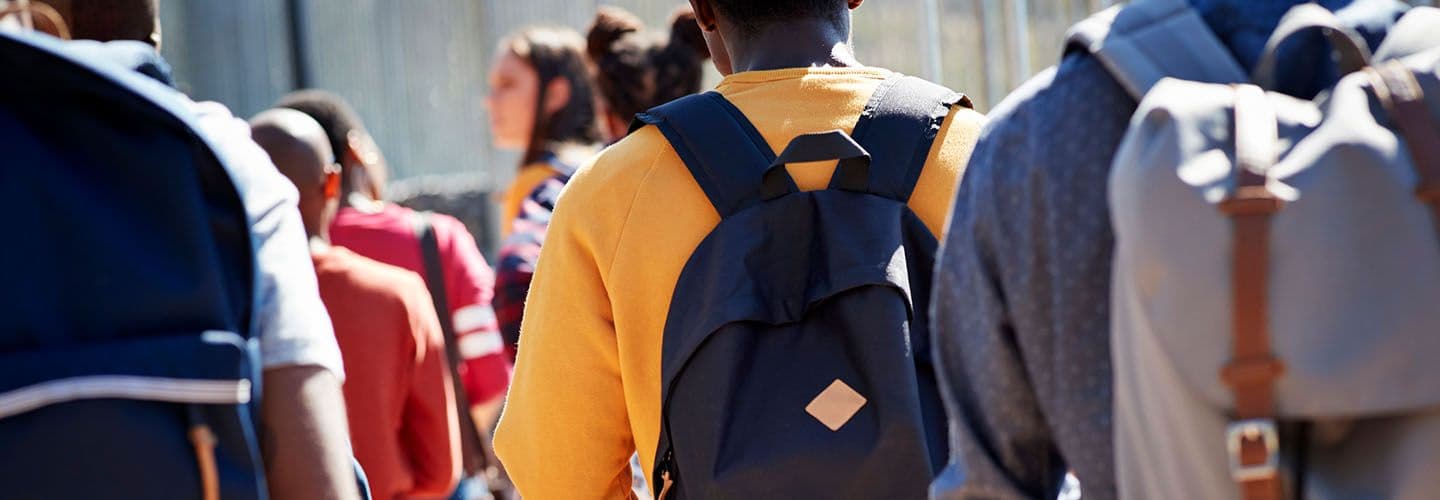


Experiencing homelessness can have a lasting impact on students’ educational outcomes and well-being.[1],[2] In California, housing costs, the limited availability of affordable housing, and natural disasters have contributed to a growing number of students experiencing homelessness in the state.[3] School districts are required by the federal McKinney-Vento Act[4] to address barriers to education faced by students experiencing homelessness, but they do so with limited resources and supports.[5] As a result, many students go unidentified and ultimately do not receive the supports and services to which they are entitled.[6]
The McKinney-Vento Act
The McKinney-Vento Homeless Assistance Act (McKinney-Vento Act) was established to remove barriers to accessing education for students experiencing homelessness. The McKinney-Vento Act relies on a broad definition of homelessness that includes staying in temporary housing due to loss of housing or economic insecurity, which may include shelters, hotels, motels, campgrounds, in the home of others, or in any place that is not an adequate nighttime residence (e.g., outside, in a car, in a building without water or electricity).
Students experiencing homelessness face barriers attending and engaging in school. For example, students experiencing homelessness may have difficulty purchasing required school supplies and/or may have difficulty accessing transportation to school due to changes in temporary housing. They also experience competing demands on their time and attention (e.g., uncertainty about where they will go after school, food insecurity, etc.), which make it more challenging to attend and participate in educational activities. The COVID-19 pandemic and wildfires throughout the state introduced new challenges for districts meeting the needs of students experiencing homelessness—challenges districts continue to address today.[7],[8]
In this brief, we provide data on students experiencing homelessness in California, drawing on data from 2018-2024 to capture changes since the COVID-19 pandemic and historic wildfires. Throughout the brief, we explore (1) how many students were identified as experiencing homelessness across the state, (2) how well California districts identified students experiencing homelessness, and (3) the funding that was available for districts to address the needs of students experiencing homelessness. We conclude with a summary of implications and recommendations followed by a detailed summary of the data sources included in the brief.
References
[1] Brumley, B., Fantuzzo, J., Perlman, S., Zager, M.L. (2015). The unique relations between early homelessness and educational well-being: An empirical test of the Continuum of Risk Hypothesis. Children and Youth Services Review, 48, 31-37. https://doi.org/10.1016/j.childyouth.2014.11.012
[2] Parrott, K.A., Huslage, M., & Cronley, C. (2022). Educational equity: A scoping review of the state of literature exploring educational outcomes and correlates for children experiencing homelessness. Children and Youth Services Review, 143. https://doi.org/10.1016/j.childyouth.2022.106673
[3] Burns, D., Espinoza, D., Ondrasek, N., & Yang, M. (2021). California’s students experiencing homelessness: Conditions, outcomes, and policy considerations. Learning Policy Institute. https://learningpolicyinstitute.org/product/students-experiencing-homelessness-report
[4] 42 USC CHAPTER 119, SUBCHAPTER VI, Part B: Education for Homeless Children and Youths
[5] Espinoza, D., Griffith, M., Burns, D., & Shields, P.M. (2023). Federal and state resources for students experiencing homelessness. Learning Policy Institute. https://doi.org/10.54300/546.264
[6] Levin, S., Espinoza, D., & Griffith, M. (2022). Supporting students experiencing homelessness: District approaches to supports and funding. Learning Policy Institute. https://doi.org/10.54300/557.894
[7] Pavlakis, A.E., Roberts, J.K., & Richards, M.P. (2021). When the old will no longer do: School and community practices for student homelessness amid COVID-19. AERA Open, 7. https://doi.org/10.1177/23328584211064305
[8] Krisha Mazumder, R., Amin Enderami, S., Rosenheim, N., Sutley, E.J., Stanley, M., & Meyer, M. (2023). Estimating long-term K-12 student homelessness after a catastrophic flood disaster. Resilient Cities and Structures, 2(2), 82-92. https://doi.org/10.1016/j.rcns.2023.07.005 https://calmatters.org/housing/homelessness/2025/01/la-fires-homeless/
Acknowledgements
This report is funded by the National Center for Youth Law (NCYL). We thank all NCYL staff, specifically the Compassionate Education System staff, for their ongoing support and partnership. We thank the McKinney-Vento Liaisons, California Department of Education data team members, and community members we spoke to during the writing of this report. Their input was invaluable in contextualizing the data presented here. The views expressed in this report are those of the authors and not NCYL.
Suggested citation
Shaw, S., Rosenberg, R., & Gebhart, T. (2025). Students Experiencing Homelessness in California. Child Trends. DOI: 10.56417/8979g5884v