
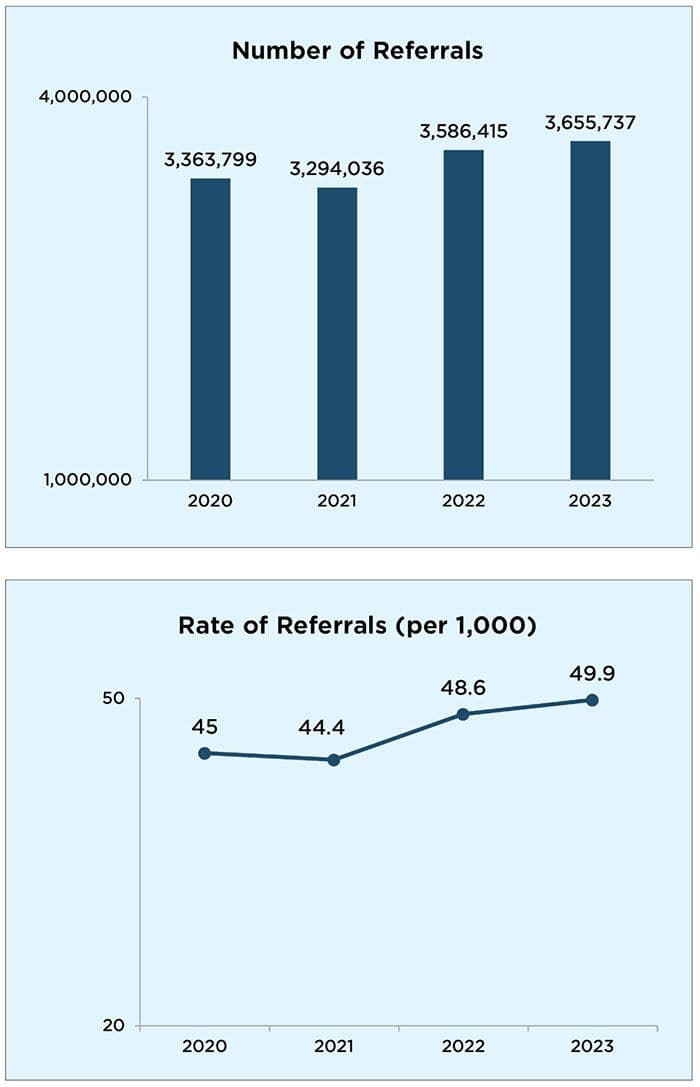
Recent Child Trends analyses of the National Child Abuse and Neglect Data System (NCANDS) show that the number of referrals made to child welfare agencies for child maltreatment continued to climb in 2023. Referrals include those that were “screened in” for investigation or for an alternative response by child protective services, as well as those “screened out” for no finding of maltreatment or unsubstantiated referrals.

Figure: Both the number and rate of referrals to child welfare agencies for maltreatment have risen since 2021
Source: The data used in this publication were obtained from the National Data Archive on Child Abuse and Neglect and have been used in accordance with its Terms of Use Agreement license. Unless otherwise noted, for each calculation, children who were missing data on the relevant indicator were excluded from analyses. The Administration on Children, Youth and Families, the Children’s Bureau, the original dataset collection personnel or funding source, NDACAN, Cornell University and their agents or employees bear no responsibility for the analyses or interpretations presented here. Datasets used include: Dataset #237, NCANDS Child File FY2019, Version 5; Dataset #244, NCANDS Agency File FY 2019, Version 3; Dataset #253, NCANDS Child File FY2020, Version 3; Dataset #254, NCANDS Agency File FY 2020, Version 3; Dataset #263, NCANDS Child File FY2021, Version 2; Dataset #264, NCANDS Agency File FY 2021, Version 2; Dataset #279, NCANDS Child File FY2022; Dataset #280, NCANDS Agency File FY 2022
Although the number of referrals has increased over the past two years, the number of substantiated cases has been decreasing. In 2022, “screened out” referrals outpaced “screened in” referrals for the first time since the pandemic began, a gap that widened further in 2023. This finding is likely due to several factors, including changes in mandated reporting practices and increased consistency in screening protocols, as cited by states in the NCANDS report. Professionals made over 70 percent of "screened in" referrals in 2023, with law enforcement and school personnel accounting for over half of these reports. Increases in “screened out” referrals may highlight a need for additional professional training on mandated reporting protocols and decision making to help determine when alternative supports outside of maltreatment reporting might be appropriate.
Child Trends experts have compiled these data and other child welfare indicators in the Child Welfare Data Interactive, a one-of-a-kind data tool that allows users to examine state and national child welfare data on entries into foster care, child maltreatment, kinship caregiving, permanency, and older youth in foster care. Data are updated annually upon release of the NCANDS and other related datasets, such as the Adoption and Foster Care Analysis and Reporting System (AFCARS). Currently, federal fiscal year 2023 is the most recent year of available data.
Interested in learning more about child welfare referrals for child maltreatment and how they are changing over time across the United States? Contact Rebecca Vivrette, PhD at rvivrette@childtrends.org.