


As of 2023, most of the youth (54%) in extended foster care were in a supervised independent living placement (SILP), like an apartment or dorm. While SILPs provide youth more freedom to learn and grow, it is unclear whether these placements also provide them with needed supports during this time. This blog looks at placement types among youth in extended foster care and the supports they may (or may not) receive in those placements. It also explains why better data on youth in extended foster care are now available and how these data could improve outcomes for older youth with foster care experience.
Extended foster care allows a young person to stay in their current placement—for example, in a relative or non-relative foster home—or move to a less restrictive setting such as an SILP. An SILP, most often an apartment or dorm room, allows young people to live independently while working with a case manager and receiving services. Past research from California shows that SILPs were the most common (31.4%) placement for youth in extended foster care at age 19, followed by a relative foster home (22.5%) and transitional housing placements (19.2%).[1] The same study found that placement type was associated with differences in who provided support—for example, who youth ask for resources or approach for emotional support.
However, placement type made no difference in the type (i.e., tangible, emotional, or informational) or adequacy of support provided to young people (i.e., their satisfaction with available support). Youth in SILPs were more likely to identify peers as their main supporters while youth in relative or non-relative foster homes were more likely to nominate adults as their main supporters. Regardless of placement type, most youth in extended foster care reported having social support.
To date, little research has explored placement type among youth in extended foster care at the national level. This is likely due to the historic lack of consistent and reliable data on the full population of youth in extended foster care. However, the Adoption and Foster Care Analysis and Reporting System (AFCARS) Technical Bulletin 22 was updated to clarify that all young people in extended foster care, regardless of funding source, should be included in the data states submit. This update has already increased the quality of data on extended foster care in the federal fiscal year 2023 file and allowed for more robust analysis based on placement type. As previously mentioned, 54 percent of all young people ages 18 to 21 in extended foster care were in an SILP in 2023, and this percentage increased by age, with 46 percent of 18-year-olds, 57 percent of 19-year-olds, and 63 percent of 20-year-olds in an SILP—indicating that young people successfully move into less restrictive placements as they age.[2]
Among youth ages 18-21 in extended foster care, more than half were in supervised independent living placements
Percentage of youth ages 18-21 in extended foster care, by type of placement
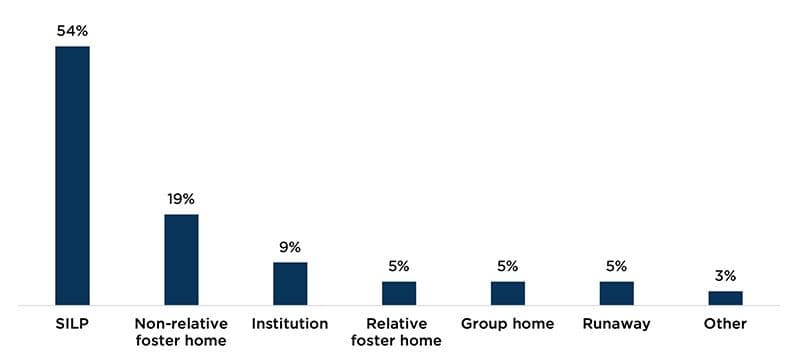
Source note: Child Trends analysis of the Adoption and Foster Care Analysis and Reporting System Foster Care File 2023. Other includes trial home visits and pre-adoptive homes.
A better understanding of placement type among older youth in extended foster care can allow systems to provide more effective services and supports. For example, understanding whether a community’s SILPs are centrally located or scattered across multiple neighborhoods could inform the number (and placement) of sites needed for easily accessible independent living services. Further, understanding placement types present in a given state may provide insight into barriers to affordable housing or a lack of landlords willing to rent to young adults with foster care experience. This information can, in turn, inform national and state-level policy and practice adjustments to ensure that young people have access to safe and appropriate placements during extended foster care.
For more information on extended foster care, please see our other blogs in this series. One blog, “Increased Use of Extended Foster Care Allows More Young People to Benefit,” explores the importance of ensuring that every eligible young person gets connected to extended foster care. The other, “Extended Foster Care Policies and Practices That Boost Young Adults’ Participation,” describes some young adult-centered policies and practices for extended foster care implementation.
Footnotes
[1] Transitional housing placements provide a more structured placement offering more resources and supervision than an SILP.
[2] Child Trends analysis of the Adoption and Foster Care Analysis and Reporting System Foster Care File 2023.
Suggested citation
Rosenberg, R., & Flannigan, A. (2026). Most youth in extended foster care live in supervised independent living placements. Child Trends. DOI: 10.56417/9666p9944z