



Most working parents and caregivers in the United States do not have access to paid family and medical leave (PFML) through their employers. As of January 2026, 13 states and Washington, DC have mandatory paid family leave systems to provide PFML to all eligible residents. Ten additional states have voluntary PFML policies, which do not require the provision of PFML. Instead, they allow the private insurance market to sell paid family leave insurance, which employers can elect to purchase for their employees and/or individuals can purchase independently.
Only 13 states and Washington, DC have mandatory PFML policies, and more than half of states have no PFML policies
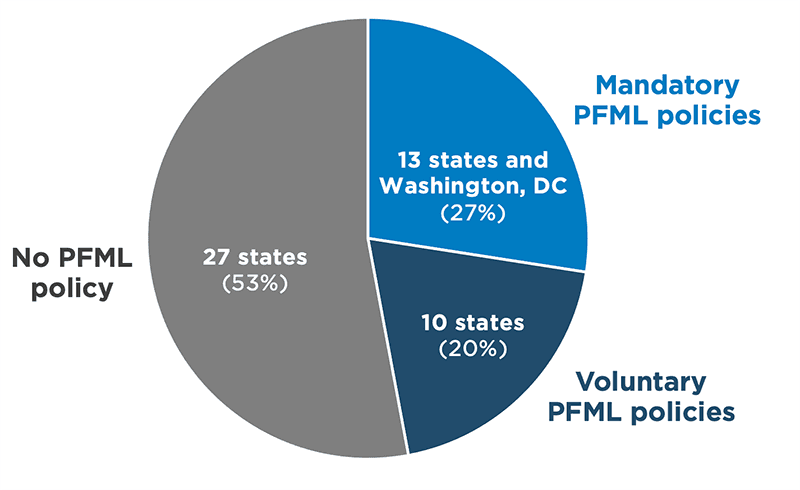
Source: State paid family leave laws across the U.S. (2025). Bipartisan Policy Center. https://bipartisanpolicy.org/explainer/state-paid-family-leave-laws-across-the-u-s/.
Note: The 13 states with mandatory PFML policies are California, Colorado, Connecticut, Delaware, Maine, Maryland, Massachusetts, Minnesota, New Jersey, New York, Oregon, Rhode Island, and Washington.
We updated the pie chart in this data point on April 17, 2026.
States’ mandatory PFML policies vary slightly, as states take different approaches when building these policies. State PFML policies offer different lengths of paid leave (ranging from 2 to 12 weeks) and adopt slightly different eligibility criteria (e.g., qualifying events, work requirements). They also use different mechanisms to fund their PFML programs. For example, some states rely on taxes on employers, while other programs are funded via employee payroll deductions; still other states use a combination of both approaches. States’ PFML programs also vary in the benefit amount, with employees able to recoup 60 to 100 percent of their wages while using PFML.
PFML allows parents and caregivers to take paid time off from work to attend to a range of family and caregiving responsibilities, including caring for a newborn, bonding with a new child in their family, or supporting a family member receiving medical treatment. Research has shown that access to PFML has positive impacts for parents, children, and communities, including improved physical health and mental health and well-being among parents and caregivers, improved children’s health, greater economic stability for families, and increased participation in the workforce among mothers. As states and localities consider policy initiatives to support children and parents, there has been a growing interest in PFML as a core strategy to promote family health and bonding.
Child Trends has developed a Guide to Evaluating Paid Family and Medical Leave Policies to help states and localities assess whether their policies are achieving their intended outcomes. If you are interested in learning more about this guide, or in working with us to evaluate paid family and medical leave policies, please contact Kate Steber, Katy Falletta, or Julianna Carlson.
Suggested citation
Steber, K., Falletta, K., & Carlson, J. (2026). 13 states and Washington, DC have mandatory paid family and medical leave policies. Child Trends. DOI: 10.56417/6343j5244g