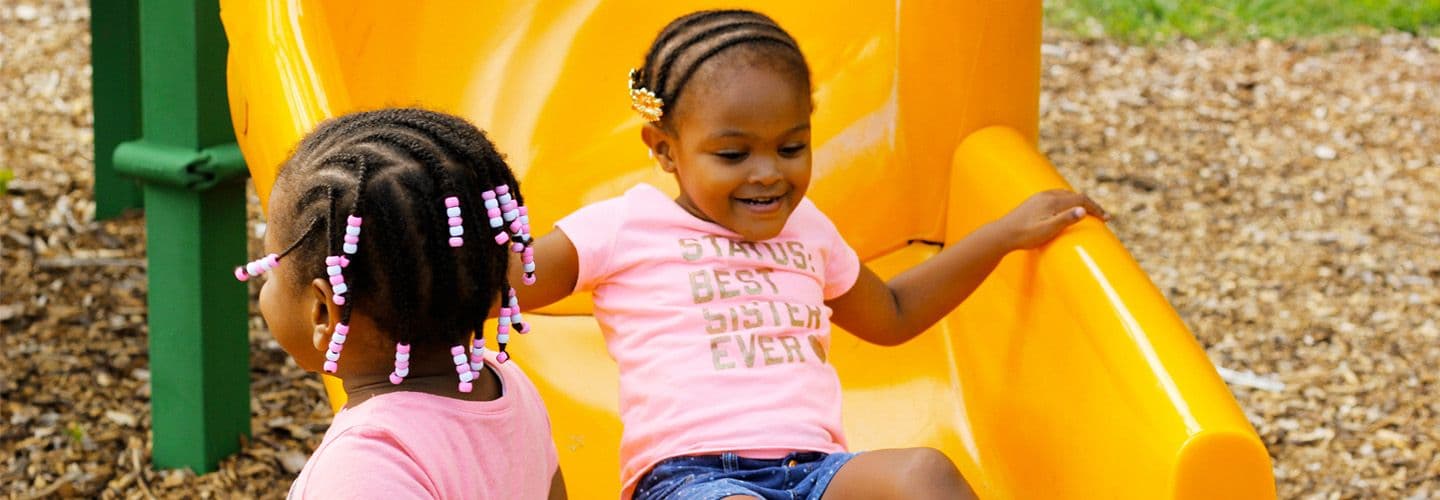




Play is a fun and integral part of a young child’s day as they learn, grow, and develop. Outdoor playspaces, such as playgrounds, offer children multiple avenues to engage in physical activity with peers, which promotes physical, social-emotional, and mental health. However, these opportunities are not universally available to families: One study found that fewer parks were available to children living in poverty, a finding that was true in both urban and non-urban settings and for children of different races.
To effectively make the case for more playspaces, we need more information on how playspaces promote children’s development. Evaluations of outdoor playspaces must consider both children’s development across multiple domains (i.e., physical, social, and emotional/mental health) and the characteristics of the playspace itself (e.g., design, quality, and utilization). This blog highlights potential tools and best practices for measuring child development outcomes in playspace evaluations.
Measures to evaluate the characteristics of outdoor playspaces and their influence on child development
We reviewed 132 different tools in total—115 child development measures and 17 playspace assessments. We narrowed the list of child development tools to 15 promising assessments:
- Battelle Developmental Inventory: Third Edition (BDI-3) Developmental Complete
- Bayley Scales of Infant and Toddler Development: Fourth Edition (BSID-4)
- Behavior Assessment System for Children: Third Edition (BASC-3) Preschool; Parent Rating Scales (PRS) & Teacher Rating Scales (TRS)
- Child Development Inventory (CDI)
- Developmental Profile-4 (DP-4)
- Devereux Early Childhood Assessment for Infants (DECA-I)
- Devereux Early Childhood Assessment for Preschoolers, Second Edition (DECA-P2)
- Devereux Early Childhood Assessment for Toddlers (DECA-T)
- Inventory of Early Development III Standardized (IED III Standardized)
- Learning Accomplishment Profile™: 3rd Edition (LAP™-3)
- Learning Accomplishment Profile™: Early version (E-LAP™)
- Learning Accomplishment Profile™: Birth to Kindergarten (LAP™ B-K)
- Peabody Developmental Motor Scales 3rd edition (PDMS-3)
- Penn Interactive Preschool Play Scales (PIPPS)
- Social-Emotional Assessment/Evaluation Measure (SEAM™)
These measures covered the developmental domains of interest noted above, were appropriate for use with children ages 3 to 5, and were classified as assessments, not screeners (since developmental screeners are only designed to identify children at risk for some form of developmental delay, which requires further assessment to confirm a diagnosis).
For measures of children’s playspace use and acceptance, we also identified 15 tools:
- 2024 KABOOM! Playspace Assessment Tool (PAT)
- Children's Activity Rating Scale
- Environment and Policy Assessment and Observation (EPAO) Tool
- Family Recreational Facility and Activity Perception Survey
- Observational System for Recording Physical Activity in Children-Preschool Version (OSRAC-P)
- Outdoor Playtime Checklist
- PlayAUDIT
- Playground Attitude and Perception Survey
- Playground Observation of Peer Engagement
- Playspace Inequity Prioritization Index (PIPI)
- Play Park Evaluation Tool (PPET)
- Preschool Outdoor Environment Measurement Scale (POEMS)
- System for Observing Play and Leisure Activity in Youth (SOPLAY) / System for Observing Play and Active Recreation in Communities (SOPARC)
- System for Observing Play and Leisure Activity in Youth to measure Shade and Nature (SOPLAY-SN)
- System for Observing Children’s Activity and Relationships during Play (SOCARP)
These tools were considered because they measured playspace use and acceptance by capturing group activity levels and/or children’s engagement with the playspaces, measured the developmental appropriateness of playspaces, and covered group social dynamics within the playspace.
The project team piloted two child development measures and one assessment of playspaces that seemed best suited for our needs: the Child Development Inventory (CDI), Developmental Profile 4 (DP-4), and the System for Observing Play and Leisure Activity in Youth (SOPLAY). These measures aligned with our priority child-level outcomes and were accessible to the research team within a short timeline, including time for training field staff. Two additional promising measures of child development stood out—Peabody Developmental Motor Scales (PDMS-3) and Penn Interactive Preschool Play Scales (PIPPS)—along with two additional useful playspace measures—the Playspace Inequity Prioritization Index (PIPI) and the 2024 KABOOM! Playspace Assessment Tool (PAT)—but we lacked time or resources for additional piloting.
Best practices for measuring child development outcomes and playspace characteristics in outdoor playspace evaluations
After piloting the CDI, DP-4, and SOPLAY in selected early childhood programs in Philadelphia, we offer the following recommendations for implementing evaluations of child outcomes and outdoor playspace characteristics.
- Select child outcome measures that capture specific developmental domains. Since measures capture different aspects of child development, evaluators should decide which aspects they want to study and use aligned measures. For example, the CDI focuses on personality traits and child demeanor, the DP-4 measures children’s developmental skills, the PDMS-3 highlights motor skills, and the PIPPS evaluates children’s play interaction and disruption. Some studies may use one measure while others use multiple.
- Identify adults who know the child well to complete developmental assessments. Evaluators have many options when selecting data collectors for child development measures, including family members, educators or providers, directors, or external observers. Pilot participants reported that data collection is more reliable when completed by someone who knows the child well (e.g., teachers or family members), especially measures of children’s behavior and emotions. That said, program directors can also contribute valuable insight and knowledge about children’s developmental needs across an early childhood program, which may inform the evaluation broadly.
- Invest in thorough training for data collectors. Initial and ongoing training help data collectors use measurement tools reliably and produce stronger results. It may be challenging for data collectors to learn to assess child outcomes as children engage with both the play structure and the surrounding natural space. It may also be hard to learn how to assess the playspace characteristics that influence both individual play and peer interactions. Training is especially important when asking early childhood program staff to use unfamiliar measures.
- Choose a documentation method—technology or paper—that works best for the task. The pilot indicated that how data are recorded is also important. Some pilot participants found it difficult to enter environmental observation data with mobile devices while simultaneously interacting with constantly moving children. Instead, they found pencil/paper forms easier to manage outdoors. Evaluators can consider which recording method works best for data collectors or whether other alternatives—e.g., coding videos of children engaging with the playspace at a later time—may work best for an evaluation.
Evaluating the role of outdoor playspaces on child development offers families, early learning providers, policymakers, and researchers more information about the value of play in a child’s development. Collectively, we can use the recommendations in this blog to plan effective evaluations that aim to assess the impact of playspace features, quality, and use on child development outcomes.
Acknowledgment
For this series that includes examining the physical, social-emotional, and mental health benefits of playgrounds, Child Trends performed the literature and measures reviews while KABOOM! staff conducted the measures pilot. KABOOM! is a national nonprofit organization focused on promoting playspace equity—i.e., addressing the limited access to high-quality and age-appropriate playspaces for children in communities experiencing the ongoing effects of systemic racism.
Suggested citation
Darling, K., Lin, V., Halle, T., & Guerra, G. (2025). How to evaluate the influence of outdoor playspaces on child development. Child Trends. DOI: 10.56417/5655v3181o