


February observances like Valentine’s Day and National Condom Week bring renewed attention to relationships and sexual health. These moments offer a timely reminder that sexual and reproductive health (SRH) is not only a personal issue, but one that shapes well-being, stability, and participation in the workforce. When employees can easily access and understand their SRH benefits, they are better equipped to protect their health, plan their families, and navigate major life decisions that directly affect their ability to show up and perform at work.
However, insights from an employer survey conducted by Child Trends and the Health Action Alliance (HAA) suggest that several factors—including stigma, limited awareness of business impacts, and hesitation by leadership—may be keeping employers from taking advantage of timely opportunities to promote SRH-related benefits that support well-being, productivity, and retention.
In this brief, we’ll discuss:
- The business case for sexual and reproductive health
- The sexual and relationship health landscape at work
- What employers can do
What Is Sexual and Reproductive Health (SRH)? Sexual and reproductive health refers to a broad range of services that cover access to contraception, fertility and infertility care, maternal and perinatal health, prevention and treatment of sexually transmitted infections (STIs), protection from sexual and gender-based violence, and education on safe and healthy relationships.
The Business Case for Supporting Sexual and Reproductive Health
More than one third of the U.S. workforce is age 16 to age 34 — a demographic that experiences disproportionate sexual and reproductive health challenges. Nearly half of all new STIs occur among people ages 15 to 24, with untreated infections leading to long-term consequences for mental health, fertility, and overall well-being. Many of these workers access health coverage through employers, either on their own plans or on their parents' plans up to age 26, making workplaces an important part of the SRH support ecosystem.
Employers are important partners in supporting sexual health through education, benefits, and access to services. Additionally, a growing body of research suggests that SRH is closely tied to business outcomes:
- Productivity: Untreated reproductive health conditions can lead to absenteeism and impaired performance.
- Talent retention: Studies indicate that use of health benefits, including SRH services, is linked with higher job satisfaction and reduced turnover intentions.
- Engagement: Positive sexual health and well-being are tied to mental health outcomes such as lower anxiety and depression, which in turn influence engagement and performance.
- Economic stability: Decisions around family planning and caregiving—including timing of childbearing and access to fertility care—affect career trajectories and participation in the labor force. Evidence suggests that improved access to reproductive health care corresponds to greater labor force participation and economic stability.
- Health care costs: Investments in comprehensive benefits, including SRH services, are more broadly associated with reduced absenteeism and lower health-related costs.
Understanding the SRH Landscape at Work
So how are employers currently thinking about and acting on these issues?
To better understand employer perspectives, Child Trends collaborated with HAA on a survey to understand current SRH-related wellness offerings and areas for future growth. Benefits, human resources (HR), and health and wellness leaders from 25 U.S. employers participated, representing small, mid-size, and large organizations. They came from a variety of industries, including insurance, construction, education, hospitality, retail, health care, and engineering.
Employers are open to SRH benefits and already offer some services.
Most respondents indicated there is room to expand SRH support within employee wellness programs, and most expressed willingness to address these topics. Currently, the most commonly addressed areas of SRH are vaccinations (such as HPV), cancer, and prenatal care. Telehealth is the most common delivery channel, with many employers also offering testing and screening supports.
Silence and stigma may leave important benefits underprioritized.
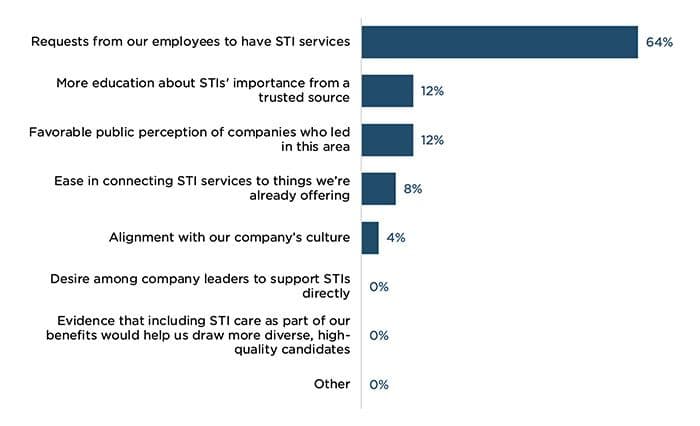
We also asked what drives prioritization of STI prevention, testing, and treatment benefits. The primary reported driver was direct employee demand (Figure 1).
Figure 1: Motivations for employers to prioritize STI prevention, testing, and treatment in workplace wellness programs
At the same time, awareness gaps remain: Most respondents (68%) did not realize that SRH issues affect their employees and their productivity (Figure 2). Some leaders also reported organizational barriers that keep SRH from being discussed more directly, including hesitation from senior leadership (20%).
Figure 2: Perceived lack of impact on employee productivity and low engagement of existing programming leads to lower employer prioritization of STI services
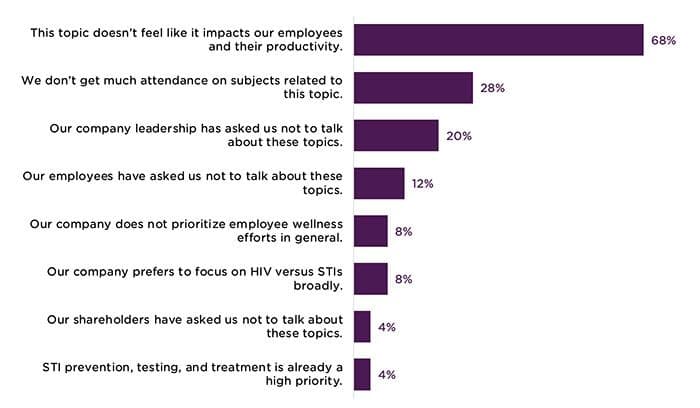
Together, these results point to an important pattern: Employers are not resistant to SRH care so much as they are still developing awareness. Many respond when needs are made visible, but stigma limits how often those needs are voiced. When sexual health feels taboo at work, a lack of discussion can be misread as a lack of demand. In other words, stigma and silence can create blind spots in designing and communicating benefits.
How Employers Can Support Employees’ SRH
Employers can take evidence-based action by strengthening policies, benefits, workplace culture, and communications to better support SRH across the employee experience.
Implement policies that expand access to care.
Business leaders can adopt practical policies that support workforce well-being while also advancing organizational goals. A useful starting point is to review benefit design and coverage options to identify opportunities to expand access to:
- STI and HIV testing
- Contraception
- Preventive and treatment medications
- Fertility care
- Family-building services
- Prenatal and postpartum care
- Mental health supports
- Telehealth services for SRH needs
Paid sick leave is another foundational way to improve access to care, allowing employees to seek services without risking lost wages or job security. Employers can also assess which segments of their workforce may face more difficulty taking time off, and equip managers to support flexible scheduling options when health needs arise.
These policies can improve attendance, retention, and workforce stability—particularly for workers with lower wages, who often face the greatest access barriers while nevertheless being central to business continuity.
Make SRH resources accessible on-site.
Time, scheduling, and transportation often represent significant barriers to accessing care. In addition to offering paid time off, employers can consider practical access to employee supports such as:
- Providing or subsidizing transportation to local clinics or community health providers
- Inviting trusted community partners to host “lunch-and-learns” or team sessions to share educational resources and services
- Using existing on-site distribution points such as workplace clinics or wellness vending machines to offer SRH supplies like condoms or self-testing kits
- Using HAA’s free guide to host an HIV testing day or similar on-site screening event for employees
Tackle stigma through culture and communication.
Creating a supportive, non-stigmatizing workplace environment helps employees use the benefits already available to them. Clear, consistent communication about sexual and reproductive health can also help employers better understand employee needs and demands. Employers can take the following practical steps:
- Incorporate SRH information into onboarding and benefits enrollment cycles.
- Normalize SRH as part of whole-person health communication strategies.
- Offer confidential benefits navigation tools and resource hubs.
- Use anonymous needs assessments and employee surveys to identify gaps and areas of demand without requiring people to disclose sensitive information publicly.
- Distribute plain-language, accessible educational materials (such as posters, emails, or brochures) to strengthen health literacy and increase appropriate benefit use.
- Equip employee resource groups with tools and training to offer peer-led education and resource distribution.
Looking Ahead
Organizations and leaders across the business community have an opportunity to move beyond symbolic gestures to take real action in support of sexual and reproductive health. When SRH information, services, and benefits are easier to access—and easier to understand and talk about—people are better able to protect their health, navigate major life decisions, and stay engaged in their work, education, and communities.
Getting started doesn’t require a major overhaul; even small, practical improvements to benefits, policies, and communications can make a real difference in people’s well-being and stability. These investments pay off not only in better business outcomes, but also in healthier relationships, families, and communities.
This publication was made possible by cooperative agreement CDC-RFA-PS-23-0007 from the Centers for Disease Control and Prevention (CDC). Its contents are solely the responsibility of the authors and do not necessarily represent the official views of the Centers for Disease Control and Prevention (CDC).
Suggested citation
Rogers, J., Rauzin, S. (2026). How employers can meaningfully support sexual and reproductive health in the workplace. Child Trends. DOI: 10.56417/7384t9946h