




New data from the 2024 Maryland Early Care and Education (ECE) Workforce Survey highlight the importance of public health insurance and the health insurance marketplace for Maryland’s ECE workforce.[1] More than 1,400 ECE workers responded to the survey, which revealed that nearly one third of ECE workers receive health insurance through Medicaid or Medicare; this includes 28 percent of center-based ECE workers and 33 percent of family child care (FCC) workers. Another 21 percent of FCC workers and 12 percent of center-based workers obtained health insurance through the state’s health insurance marketplace, where many plans are federally subsidized for eligible consumers (Figure 1).
Nearly one third of Maryland ECE workers receive health insurance from Medicaid or Medicare
Percentage of center-based and family child care (FCC) ECE workers in Maryland, respectively, who receive health insurance by source
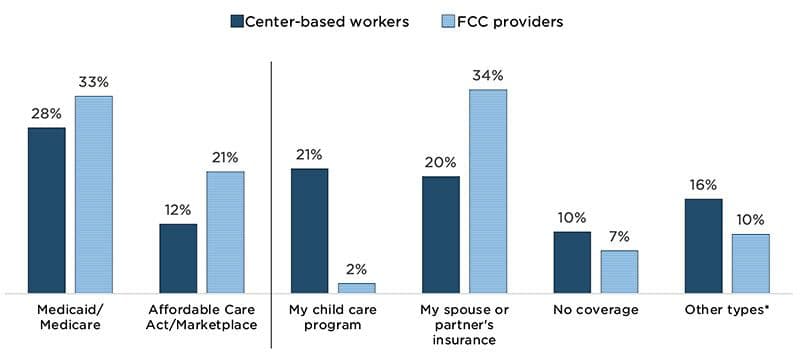
Note: ECE workers could select more than one source of insurance.
*“Other types” included insurance through another employer, through a parent’s insurance, and through another type not listed in the survey.
Source: MD Child Care Policy Research Partnership November 2024–December 2024 Workforce Survey
The survey also found that 21 percent of center-based workers and just 2 percent of FCC workers receive insurance through their child care employer.[2],[3] Without access to employer-sponsored insurance plans, FCC workers, in particular, often rely on their spouse or partner’s insurance plan: 20 percent of center-based workers and 34 percent of FCC workers receive insurance this way. Finally, 10 percent of center-based workers in Maryland were uninsured, as were 7 percent of FCC workers; nationally, 13 percent of ECE workers are uninsured.
Rates of Medicaid/Medicare receipt among Maryland’s ECE workforce are similar to those nationwide, where 28 percent of ECE workers receive Medicaid. Notably, Maryland expanded Medicaid eligibility in 2014; ECE workers in states that did not expand Medicaid were four times more likely to be uninsured than those in other states in 2023. Many child care workers earn wages too low to afford private insurance, leaving Medicaid or marketplace plans as their primary options for coverage. However, with recent changes to federal health care policies—including new Medicaid policies and increased costs of marketplace health insurance plans—Maryland ECE workers will find it more difficult to access these options. As a result, more ECE workers may be uninsured or leave the field for other jobs that offer better access to health benefits.
See our Maryland Child Care Policy Research Partnership website to learn more about Child Trends’ partnership with the Maryland State Department of Education.
Footnotes
[1] The Maryland Child Care Workforce Survey gathered data for providers from licensed programs only, including private child care programs and nursery schools, private preschool/pre-K programs, Head Start programs, and public pre-K programs that are not public school-based. “Worker” refers to center-based teachers, center-based floaters/aides, and FCC providers.
[2] Pre-K and Head Start educators are more likely to receive health insurance from their employer, which may have affected the overall percentage of workers with employer-sponsored health insurance. Among center-based educators, 54 percent indicated having health insurance offered to them by their program.
[3] Nationally, about one in four (21%) ECE workers get health insurance through their child care employer. (Note: An early version of this footnote stated that, nationally, 28 percent of ECE workers receive health insurance through their child care employer.)
Suggested citation
Ulmen, K., Lin, Y., Madill, R., & Banghart, P. (2026). One in three ECE workers in Maryland receive health insurance through Medicaid or Medicare. Child Trends. DOI: 10.56417/4701j694g