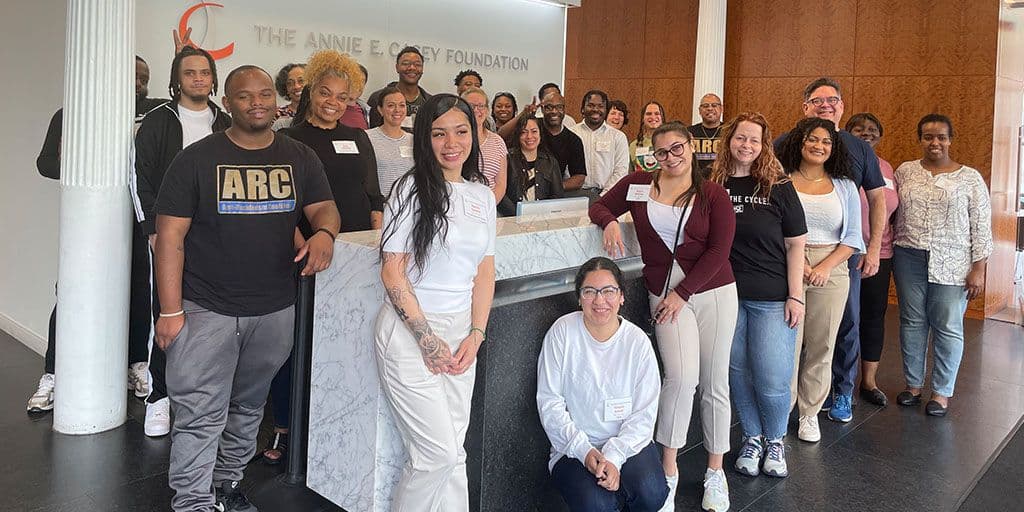

Strengthening program engagement and leadership among emerging adults can help address broader structural barriers that shape young people’s opportunity. Through the Supporting Emerging Adults Developmental Framework project, Child Trends, Michelle L. Farr (JUST alittle LOVE LLC, or JaL), and the Annie E. Casey Foundation partnered with community providers (see box) who work with systems-involved emerging adults to promote workforce development strategies using the Emerging Adult Justice Developmental Framework (EAJDF). This blog describes how using the EAJDF to establish a Community of Learning (CoL) with these organizations helped them develop practical, developmentally appropriate approaches to engage emerging adults in workforce development.
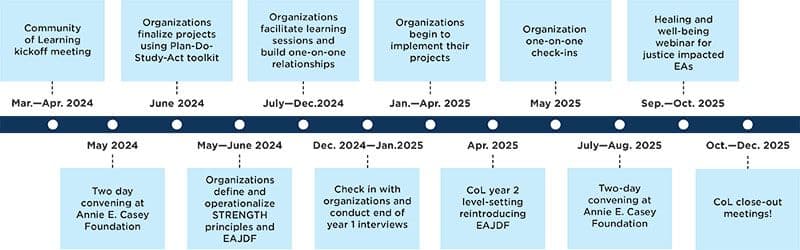
The “Emerging Adults and Workforce” CoL began in 2024 with six local AECF partner organizations willing to focus on workforce development and education opportunities that promote positive outcomes for systems-involved emerging adults up to age 25. The project partnership helped each organization establish an implementation team of two staff members and two emerging adults to adopt the EAJDF. Child Trends and partners provided individualized technical assistance,[1] presentations on the theoretical material grounding the work, and peer-to-peer facilitation sessions (led by each organization). See Figure 1 for a timeline of CoL activities across the first two years.
Figure 1: Timeline of Community of Learning activities, March 2024 to December 2025
Strategies that strengthened emerging adult engagement
Participation in the CoL had many positive outcomes for both organizations and the emerging adult teams. Through interviews and focus groups, organizations reported an increased understanding of the unique developmental needs of emerging adulthood. The following strategies, used by CoL partner organizations to promote authentic engagement, offer a practical roadmap for other providers and system partners looking to translate developmental frameworks into workforce-focused supports.
- Engage emerging adults at every step. Emerging adults participated in CoL planning meetings, in-person convenings, and panel discussions, and had the opportunity to provide feedback through interviews, focus groups, and surveys. Both the research team and leadership from the emerging adults’ respective organizations implemented this feedback. For example, in Year 1, emerging adults asked for more opportunities to meet in spaces designed just for them, so the second in-person convening provided them with space and time to participate in sessions from the EYE curriculum focused on wellness and resilience strategies. The emerging adults at RISE organized and led a panel discussion in Year 1 with both organizational and probation staff to share the importance of understanding young people’s needs by centering their voices.
- Provide leadership opportunities. Organizations reported that emerging adults took on leadership roles, initiated efforts to recruit their peers, supported feedback processes, and helped establish data collection systems. At Fortune Society, two emerging adults worked with senior staff to develop an anger management program, a financial literacy program, and a 24/7 hotline for other young people receiving the organization’s services. Emerging adults at TEEM developed an advisory council and shared a survey with other young people to identify how the organization could create a safe and trustworthy environment. Lastly, at ARC, emerging adults and staff designed a 24-week program for transition-aged youth and identified funding resources to support the program’s development.
- Develop leadership skills through training and practice. Organizations offered training on facilitation, leadership, and curriculum development, along with opportunities for emerging adults to lead organizational initiatives. At FreeMinds, emerging adults worked with a facilitation coach to create a youth-led book club and received training on facilitating and leading sessions. At TEEM, emerging adults became Certified Peer Recovery Specialists, which led to one participant securing employment.
- Support pathways to employment and leadership. Some emerging adults in the CoL became employees within their organizations, while organizational support helped others find jobs elsewhere. Both of the Fortune Society’s emerging adult participants are now full-time employees while also serving as advocacy leaders within their community. At FreeMinds, one young adult graduated from college while participating in the CoL, became a part-time employee of the organization, and received a grant from the Canary Impact as a justice-involved leader. At UTEC, one emerging adult enrolled in a culinary training program.
- Sustain engagement through transitional life stages. Several organizations struggled with the reality that some emerging adults are in transitional life stages, which can impact their ability to commit in the long term. To sustain engagement, organizations implemented councils and committees focused on community and culture-building, with shared guidelines and norms; these groups will be led by emerging adults beyond the CoL.
When emerging adults are engaged as partners—and not just as participants—organizations can build programs that are more responsive, trustworthy, and aligned with young people’s real-world goals. The CoL organizations strengthened engagement by sharing power, committing to learning from each other, creating leadership pathways, and designing structures that accommodated life transitions. Within the COL, all partners embraced the lessons and insights gained via authentic partnership with emerging adults.
Footnote
[1] Technical assistance included webinars, a biweekly newsletter with resources, peer-to-peer facilitated sessions, site visits, monthly coffee hours, one-on-one check-ins, and other assistance tailored to each organization’s needs.
Suggested citation
Abdi, F.M. (2025). Developmentally appropriate workforce development strategies for engaging justice-impacted emerging adults. Child Trends. DOI: 10.56417/1590i1714v