


More than one in four (27%) children and youth (birth to age 21) in foster care are reported to have a diagnosed Special Health Care Need (SHCN), compared to 21 percent in the general population, according to Child Trends’ update to analysis originally completed in 2020. Among children and youth in foster care with an SHCN—irrespective of age—the two most common SHCNs are “emotionally disturbed” (57%) and “other diagnosed SHCN” (59%). The ‘other’ category includes “conditions other than those noted (emotionally disturbed, visual or hearing impairment, physically disabled, or mental retardation) which require special medical care such as chronic illnesses.”[1]
The prevalence of SHCNs among children and youth in foster care varies by age and increases as children get older: 20 percent of those from birth to age 12 in foster care have a diagnosed SHCN, compared with 39 percent of those ages 13-21. The mean age of those diagnosed with an SHCN is 11. However, some SHCNs do not develop until youth are older and it is recommended that children and youth receive ongoing assessments while in foster care—factors that may contribute to the increase in prevalence among older youth.
More than 1 in 4 (27%) youth in foster care had an SHCN in 2024
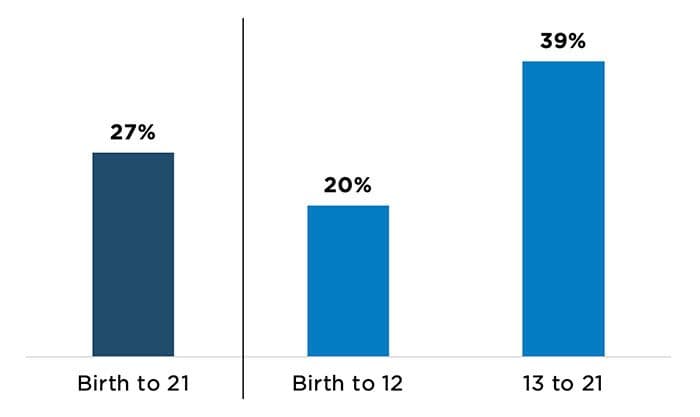
Source: Child Trends' analysis is based on 2024 data, the most recent year for which data are publicly available, from the Adoption and Foster Care Analysis and Reporting System (AFCARS). Children and youth from birth to age 21 were included in the analysis and marked as having a special health care need if they were reported to have one or more of the following conditions: emotionally disturbed, visual or hearing impairment, physically disabled, mental retardation, or other diagnosed condition. Note: Many terms used in AFCARS to describe SHCNs are considered outdated. For clarity and consistency with AFCARS, we use the language and terms used in the survey.
The prevalence of SHCNs among children and youth in foster care varies greatly by state, ranging from 0 percent in Washington, DC and West Virginia to 91 percent in Arkansas. This variance may be due to a number of factors, including differences in states’ data reporting procedures, differences in how they define SHCNs, and differences across states in the availability of general and specialized health care needed to diagnosis an SHCN.
Children and youth with SHCNs enter foster care at higher rates than their peers without an SHCN. Further, they have different experiences once in foster care, including longer stays in foster care, multiple placements, and exit to permanency at lower rates than their peers without an SHCN. Research shows that children and youth who enter foster care often have less access to appropriate health care before entering foster care. This lack of appropriate health care can continue during foster care for children and youth when services and supports are not widely accessible.
Interested in working with Child Trends to examine key child welfare indicators? Contact Rachel Rosenberg, PhD at rrosenberg@childtrends.org.
Footnote
[1] Terms like “emotionally disturbed” and “mental retardation” are widely considered outdated. However, for clarity and consistency, we use the terms as they are reported in the Adoption and Foster Care Analysis and Reporting System (AFCARS).
Suggested citation
Rosenberg, R., & Muñoz, K.S. (2026). More than 1 in 4 children and youth in foster care have a special health care need. Child Trends. DOI: 10.56417/2663t7808z