

New analyses from Child Trends find that nearly two thirds of U.S. 3-year-olds are on track in the developmental milestones and behaviors that support a successful transition to kindergarten—in other words, they are Healthy and Ready to Learn (HRTL).

The HRTL measure assesses five domains of development: Early Learning Skills (e.g., language, literacy, early math), Social Emotional (e.g., children’s understanding of their own and others’ emotions, sharing/taking turns), Self-Regulation (e.g., attention, calming down, transitions), Physical Health (e.g., health conditions, overall health rating), and Motor Skills (e.g., drawing, bouncing a ball). HRTL is completed by parents as part of the National Survey of Children’s Health (NSCH). Child Trends analyzed national samples of 3-year-olds from the combined 2022-2023 NSCH.
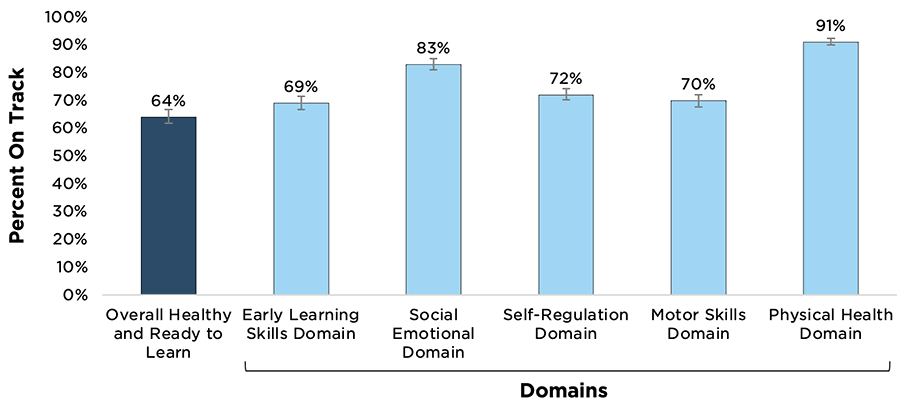
As shown in Figure 1, 64 percent of 3-year-olds are on track on HRTL overall (defined as being on track across at least 4 of 5 domains). The percentage on track in individual domains varies, with approximately 7 in 10 on track in Early Learning Skills, Self-Regulation, and Motor skills; more than 8 in 10 on track in Social Emotional skills; and more than 9 in 10 on track in Physical Health.
Figure 1. Nearly two thirds of 3-year-olds are Healthy and Ready to Learn, with higher readiness in individual domains
Note: Overall Healthy and Ready to Learn is defined as being on track in at least 4 of 5 individual domains.
Source: Authors’ analysis of the 2022-2023 combined National Survey of Children’s Health.
These data are the first of their kind: a holistic, population-level look at 3-year-olds’ development available in an annual, national survey. Data are also available by state, and for children ages 4 and 5. These data offer indicators of young children’s well-being that researchers, policymakers, stakeholders, and advocates can monitor, allowing states to track progress toward improving child well-being—particularly in response to new policies or changing conditions. The ability to understand population-level development among 3-year-olds, specifically, can provide early notice of concerns and is useful for designing and implementing programs, policies, and strategies that support children before they enter kindergarten. Moreover, having these data available over time provides a benchmark for tracking progress. The NSCH includes a variety of child, family, and community characteristics, allowing further analysis of the conditions that support or hinder being HRTL.
To see your state’s data on 3- to 5-year-olds’ developmental status in 2022-2023, visit the Data Resource Center for Child and Adolescent Health Interactive Data Query and select Indicator 5.11. For an overview of items in each domain, please see this Data Brief.
Interested in working with Child Trends on tracking school readiness? Contact Dr. Katherine Paschall at kpaschall@childtrends.org.