
As part of the Morehouse Family Health Study, Child Trends is evaluating Parent Toolkit 2.0, a family health toolkit designed to help parents and caregivers improve their knowledge and communication about adolescent health. By equipping parents and caregivers with essential skills and information, the toolkit aims to enhance teens’ decision-making skills, reduce risky sexual behaviors, and improve overall adolescent health outcomes.
Parent Toolkit 2.0—originally developed by the Georgia Campaign for Adolescent Power and Potential and adapted by Morehouse School of Medicine—is a three-week program that incorporates an online, self-paced parent guide; videos modeling parent-teen communication around sex and contraception; and two group-based sessions for parents to discuss program content and improve communication skills. This five-year project (2023-2028) is supported by the Office of Population Affairs (OPA) of the U.S. Department of Health and Human Services (HHS).
Background and Intended Impacts
Historically, rural communities in the South have experienced unequal access to culturally responsive sexual education and health care resources, leading to higher rates of risky sexual behaviors and teen pregnancies—both compared to other geographical regions and to the United States as a whole.
Going forward, it will be critical to address the needs of youth in rural communities to reduce health disparities and promote better sexual health outcomes for all adolescents.
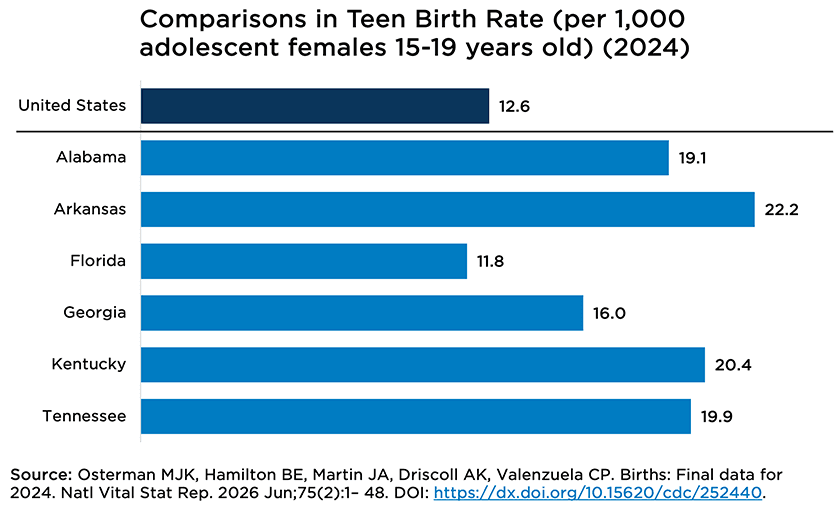
While previous studies have illustrated the pivotal role of communication between parents and their children in promoting positive adolescent sexual health, there are limited evidence-based family programs specific to rural communities. By rigorously evaluating Parent Toolkit 2.0, our study aims to measure how a program tailored for youth and families in rural communities impacts health outcomes via improved parent and caregiver knowledge and communication about adolescent health.
Research Approach
To evaluate Parent Toolkit 2.0, we are conducting a randomized control trial that examines individual-level data in rural communities across six rural states: Alabama, Arkansas, northern Florida, Georgia, Kentucky, and Tennessee. In partnership with Morehouse School of Medicine and Tressa Tucker & Associates, we are enrolling 1,000 pairs (or dyads) of parents/caregivers and their 12- to 16-year-old teens to assess the impact of the three-week program on adolescent health outcomes.
Our evaluation uses surveys, focus groups, and program observations to provide a comprehensive understanding of the intervention's impact. Our evaluation prioritizes the cultural and social norms of our target population to inform how we design, recruit, and talk about the study. Throughout the course of the project, we will also actively engage with rural parents and teens to refine the study to appropriately reflect their experiences.
Timeline
- May-July 2024: Pilot the study
- October 2024: Full impact evaluation, with ongoing recruitment and enrollment until June 2027
- July 2027-August 2028: Analysis and final reporting
If you are interested in learning more about the study, email our team at: morehousefamilystudy@childtrends.org.
Publications and Presentations
Publications
- Six Strategies for Engaging Rural Communities in Teen Pregnancy Prevention Research and Programming
- Designing a Culturally Responsive Impact Evaluation of a Parent-teen Sexual Health Program in Rural, Black Communities (a blog post for the Youth Focused Evaluation AEA365, sponsored by the American Evaluation Association)
Presentations
- “Influencing Teens’ Sexual Health via Parent and Caregiver Education: Developing, Refining, and Evaluating the Parent Toolkit Program in Rural Georgia”—Roundtable discussion at the 2026 National Sex Ed Conference in February 2026
- “Ask, Listen and Refine” Presentation at the Office of the Assistant Secretary for Health’s Teen Pregnancy Prevention Conference in July 2024—Presentation slides available upon request
Project Team
Child Trends
- Jennifer Manlove, PhD (principal investigator)
- Shana Rochester, PhD (project director)
- Elizabeth Cook, MSPH (lead evaluator)
- Deja Logan
- Julia Tallant
- Rebekah Stafford
- Elizabeth Quinteros
Morehouse School of Medicine
- Mary Langley, PhD (project manager)
- Diona Dallas
- Chaise Jones
Tressa Tucker & Associates (recruitment lead and local evaluation support)
- Tressa Tucker, PhD
- Chinwe Ejikeme, PhD
- Sadia Sleweon
Katalýtis for Change (facilitation lead)
- Sherwanna Clarke, PharmD
- Alice Jackson
Georgia Campaign for Adolescent Power and Potential
- Quashavis Ross
This five-year project (2023-2028) is supported by the Office of Population Affairs (OPA) of the U.S. Department of Health and Human Services (HHS) as part of a financial assistance award totaling $5 million with 100 percent funded by OPA/OASH/HHS. The contents of this webpage are solely the responsibility of Child Trends and do not necessarily represent the official views of, nor an endorsement by, OPA/OASH/HHS or the U.S. government.