The Minnesota Department of Children, Youth, and Families (DCYF)[1] contracted with Child Trends to independently evaluate Parent Aware—Minnesota’s voluntary quality rating and improvement system (QRIS) for early care and education programs—using an equity lens. This evaluation was required by law and funded by the federal American Rescue Plan Act, as determined by the 2021 Minnesota State Legislative Session.
The goal of the evaluation was to understand the degree to which Parent Aware supports positive outcomes for Minnesota’s children, families, and early care and education workforce. The evaluation, which took place from March 2022 to September 2024, explored these topics:
- The availability of high-quality early care and education programs in Minnesota
- Parents’ experiences accessing quality in early care and education and their opinions of Parent Aware
- Rated and unrated early educators’ experiences with and perceptions of Parent Aware
- Early care and education programs’ ability to serve children and families, including those from racially, ethnically, and culturally diverse backgrounds
- Community members’ feedback and ideas about efforts to revise and improve Parent Aware
- Children’s healthy learning and development
More detailed information about the various activities under this evaluation and the timeline for each activity can be found under Evaluation Activities and Timeline (below).
Project Updates
To share progress on the evaluation, our team posted periodic updates on this webpage over the course of the project.
Project Update—September 2024
We are excited to announce that the Child Trends team has completed work on the Parent Aware Evaluation! This webpage has been updated to include links to the reports and other products that our team developed to synthesize key findings from each evaluation activity and implications for the Parent Aware Redesign. These reports are listed in the “Completed Reports” sidebar at the top righthand corner of this webpage and also hyperlinked throughout the Evaluation Activities and Timeline section below.
On behalf of the entire team at Child Trends, we would like to thank the many early educators, families, coaches, state QRIS administrators, and other individuals who took the time out of their busy schedules to share their experiences and stories with our team. This work would not have been possible without their help! For their continued partnership in this work, we would also like to thank our project officer Lynda Rhodes; the entire team at the Minnesota Department of Children, Youth, and Families; and members of the State and Community Evaluation Advisory Committees.
The Child Trends team has a few exciting updates to share about our progress on the evaluation since March 2023!
In collaboration with DHS and our State and Community Evaluation Advisory Committees, we revised and expanded our evaluation activities. For the context behind these changes to the evaluation, see the March 2023 update below. You can read more about our plans in the Evaluation Activities and Timeline section.
We released two reports that detail findings from activities to support improvements to Parent Aware quality standards:
- Insights on QRIS from Six States & a Literature Review includes insights gleaned from a literature review and interviews with QRIS administrators in six other states to learn how states are revising their QRIS and quality standards to promote equity and system alignment.
- Parent Aware Standards and Indicators: A Multi-Cohort Analysis outlines findings from an analysis of administrative data to understand how programs select indicators to earn their desired Star Rating.
Over the last six months, the Child Trends team heard from over 400 child care providers and 300 families across the state in surveys and focus groups. These interactions revealed families’ and providers’ experiences with the state’s child care system, the challenges they face, and how state systems like Parent Aware could better support them. In early fall, we will release a public report summarizing our findings.
In collaboration with DHS and Portage Partners Consulting, we received feedback from over 2,000 providers, families, public officials, and others across the state on proposed changes to Parent Aware. Our team is currently analyzing the feedback and developing a report (to be released this summer) outlining key themes and implications for the Parent Aware Redesign.
Lastly, to ensure that evaluation findings can inform meaningful improvements to Parent Aware, we are extending the timeline for the work through September 30, 2024 (instead of July 31, 2024). This extension will give the Child Trends team more time to develop a final report summarizing lessons learned across all activities completed under the evaluation. Stay tuned for more updates in the coming months!
An important aspect of the Parent Aware Evaluation is to examine the degree to which Parent Aware Ratings capture a program’s quality, as well as the extent to which young children’s growth and learning over time are associated with Ratings. In Fall 2022, the Child Trends team launched this component of the evaluation and began recruiting child care programs and families to participate. However, many programs we contacted were unable to participate; most reported that they did not have time, that they faced ongoing challenges with staffing or staff turnover, or a host of other reasons related to the pandemic’s lingering effects on the child care sector.
Nevertheless, the Child Trends research team is moving forward with the study among the programs that agreed to participate. Because the work is at a much smaller scale, we have a more limited ability to address the originally proposed research questions. The team has been working closely with the Minnesota Department of Human Services to consider different activities for this evaluation using funds originally intended to support the activities related to program quality and children’s development.
The Child Trends team is still finalizing plans for the next year of the evaluation and will engage key partners—including the evaluation’s State and Community Advisory Committees, advocates, and others—to receive feedback on the newly proposed activities. Once our plans are finalized, we will post additional updates to this webpage and update the evaluation activities and timeline below to reflect the new activities. Stay tuned for more updates soon!
Evaluation work is already well underway! The Child Trends team has reviewed prior research to understand how the state can support program quality. Child Trends has also interviewed QRIS administrators from five other states to understand how Parent Aware compares to other states’ quality rating and improvement systems. Additionally, the team has compared the various pathways through which programs can become Parent Aware Rated and analyzed administrative data to understand statewide participation in Parent Aware. Findings from this work and considerations for ongoing improvements to Parent Aware will be shared via our final report, which we expect to release in July 2024.
This fall, Child Trends will be contacting Parent Aware Rated programs to ask them to participate in study activities during the 2022-23 school year. These activities will include a recorded classroom observation, surveys about providers’ personal and professional characteristics, and questionnaires about children’s development.
Evaluation Activities and Timeline
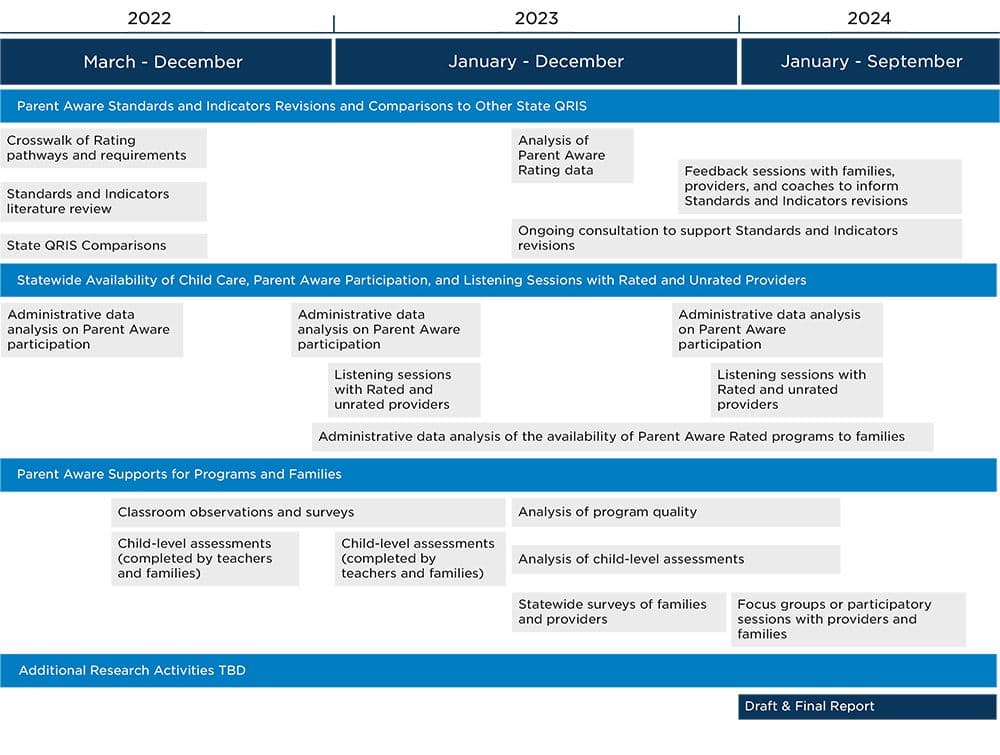
The evaluation took place from March 2022 to September 2024 and included the following research activities.
To support revisions and improvements to the Standards and Indicators that Parent Aware uses to define quality in early care and education settings, our team conducted:
- An examination of Parent Aware’s Standards and Indicators for defining program quality and a comparison of Parent Aware with other states’ QRIS using interviews with state QRIS administrators and secondary data to examine state QRIS policies, implementation practices, and approaches to embedding equity in their QRIS (see the completed report here: Insights on QRIS from Six States & a Literature Review; see a blog post about our findings here: 4 Trends in Early Care and Education Quality Rating and Improvement Systems)
- An analysis of Parent Aware Rating data to understand how participating programs select Indicators to earn points toward their desired Star Rating level, including whether there are specific Indicators that few or most programs meet and implications for how Parent Aware helps programs meet Indicators (see the completed report here: Parent Aware Standards and Indicators: A Multi-Cohort Analysis)
- Stakeholder engagement with families, early educators, and Parent Aware coaches to gather input on proposed revisions to Parent Aware Standards and Indicators, developed in collaboration with DCYF (see the completed report here: Parent Aware Redesign: Spring 2024 Public Engagement Report on Ideas for Changes to Standards and Indicators)
- Other ongoing consultation and research support to inform improvements to Parent Aware Standards and Indicators, provided by our team of experienced researchers with expertise in early care and education quality, children’s development, and equity
To explore the early care and education landscape in Minnesota and understand the factors that support or create barriers to programs participating in Parent Aware, our team conducting:
An analysis of the statewide availability of child care and Parent Aware Rated programs, with comparisons to understand where programs are located in the state relative to the communities being served
- Listening sessions with Rated and Unrated programs to understand their experiences with and perceptions of Parent Aware, including the application processes, any administrative or financial burden of participating in Parent Aware, and the degree to which Parent Aware supports the racial, ethnic, cultural, and linguistic diversity of child care programs and the families they serve
To assess quality and children's development in Rated programs and determine the impacts of the COVID-19 pandemic on Minnesota’s children, families, and child care providers, our team is conducting the following evaluation activities:*
*Note that these activities have been modified from those originally planned. These changes result from feedback from early care and education programs regarding their limited capacity to participate in an evaluation as a result of the heightened stressors and barriers they continued to face in the wake of the COVID-19 pandemic. See the Project Update posted March 2023 for more information.
- A comparison of the various pathways through which programs can become Parent Aware Rated and a review of associated requirements
- An analysis of quality and assessments of children’s development in Parent Aware Rated programs, with an emphasis on understanding programs’ practices related to diversity, equity, and inclusion, as well as the unique context of the COVID-19 pandemic and its impact on children’s early learning experiences (see the completed brief here: Methods and Measures for Understanding Children’s Experiences in Parent Aware Rated Programs)
- A statewide survey and focus groups with early educators and families with young children to understand their experiences providing and accessing early care and education during and in the aftermath of the pandemic, impacts to their needs and ability to access services, changes in their perceptions of program quality, what families and early educators notice about children’s developmental strengths and areas of need, and opportunities for Parent Aware to better support the needs of early educators and families (see the completed report and fact sheet here: Families’ and Early Educators’ Experiences With the Early Care and Education System in Minnesota)
A detailed overview of all evaluation activities, findings, and implications for future improvements to Parent Aware was included in our final evaluation report submitted to DCFY in September 2024. You can see the final report here: Evaluation of Parent Aware: Key Findings and Implications for the Parent Aware Redesign.
A timeline for each component of the evaluation is provided below.
Community Engagement
Throughout the project, the Child Trends team asked various stakeholders and members of the community to provide feedback on the evaluation through two committees:
- State Advisory Committee (met annually): staff from DCFY and the Minnesota Departments of Education, Health, and Management and Budget, as well as the Children’s Cabinet
- Community Advisory Committee (met approximately once every four months): representatives from state government agencies, Child Care Aware of Minnesota, advocacy and research organizations, and early care and education providers
Contact
If you have questions about the Parent Aware Evaluation, please contact Lyn Rhodes, the DCYF Project Manager for the evaluation, at lynda.rhodes@state.mn.us.
Project Partners
- Kristine Andrews, Ideas to Impact Consulting
- Jennifer Valorose & Briellen Griffin, Wilder Research
- Stephanie Currenton, Center on the Ecology of Early Development (CEED) at Boston University
Project Staff
- Co-principal investigators: Jennifer Cleveland, Kathryn Tout
- Project director: Rowan Hilty
- Equity lead: Kristine Andrews
- Task leads: Erin Bultinck, Audrey Franchett, Holly Keaton, Jing Tang, Mallory Warner, Abigail Wulah, Zipi Diamond, Keiyitho Omonuwa, Shreya Mukhopadhyay, Dianne Louise Maglaque, Catherine Schaefer, Yuko Yadatsu-Ekyalongo
- Additional project staff: Porsche Boddicker-Young, Ashley Hirilall, Alexandra Verhoye, Hannah Wodrich, Nia-Simone Woods, Kylee Novak, Theresa Sexton
- Data collection staff: Helen Sabrowsky, Heather Smith

Footnote
[1] The Minnesota Department of Children, Youth, and Families (DCYF) launched on July 1, 2024. From July 2024 to July 2025, state programs and staff will gradually transfer to DCYF from the Departments of Human Services, Education, Health, and Public Safety. As this new agency is established, documents may have previous agency logos or names and the DCYF website may temporarily redirect to original agency web pages. For more details, visit the DCYF website.